
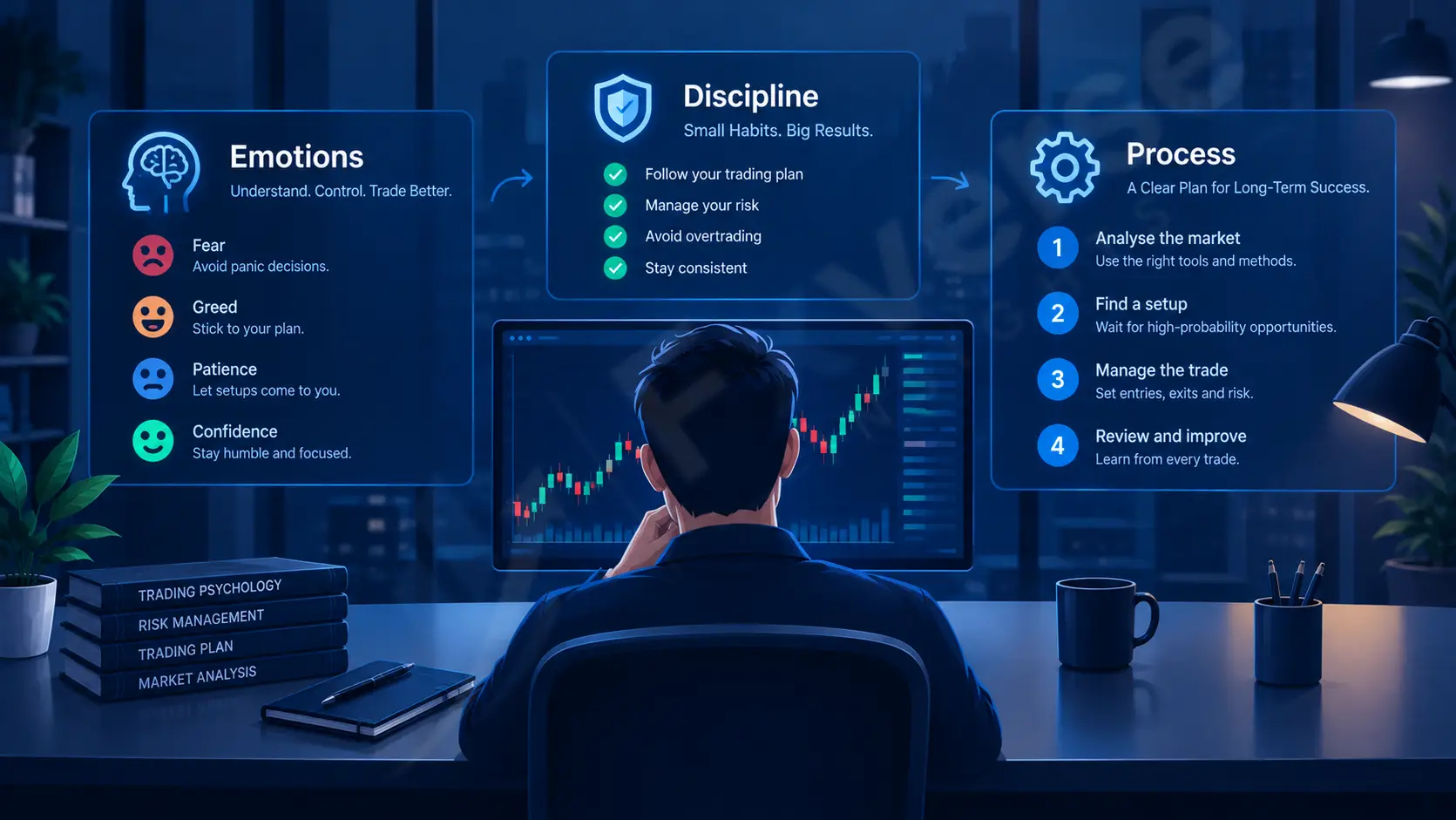
Trading psychology refers to the emotional and mental factors that influence a trader’s decisions, including fear, greed, discipline, and impulse control. Beginners who understand trading psychology can better equipped to follow a plan, manage risk, and avoid costly emotional mistakes like revenge trading or chasing losses.
A trader can have a solid strategy, a tested entry signal, and a clear stop-loss, and still lose money. Why? Because the trade never executed the plan. Fear crept in and closed the position too early. Greed kept a winning trade open too long. A string of losses triggered an impulsive decision to “make it back” immediately.
This is trading psychology in action. It’s the invisible layer behind every buy and sell decision, and for beginners, it’s often the difference between a strategy that works on paper and one that fails in practice.
This guide breaks down the core psychological patterns that affect new traders, explains why process matters more than any single outcome, and offers a practical checklist for building discipline from day one.
What Is Trading Psychology?
Trading psychology describes the mental and emotional state that shapes a trader’s decisions before, during, and after a trade. It covers how traders respond to winning streaks, losing streaks, uncertainty, and pressure.
Two traders can use the identical strategy and get different results. The variable isn’t the strategy. It’s how consistently each trader executes it under emotional stress.
Common psychological challenges for beginners include:
- Fear of losing money
- Greed or overexcitement during winning trades
- Fear of missing out (FOMO) on a moving market
- Loss aversion, or the tendency to fear losses more than they value equivalent gains
- Overconfidence after a few successful trades
- Revenge trading after a loss Each of these patterns is explored below.
Fear and Greed in Trading
These two emotions sit at opposite ends of the same problem: emotional decision-making that overrides a trading plan.
Fear typically shows up after a loss or during volatile price swings. It can cause a trader to exit a position too early, hesitate on a valid setup, or avoid trading altogether after a rough week.
Greed tends to appear during a winning streak. A trader might increase position size beyond their plan, ignore a stop-loss because “it’s working,” or hold a winning trade too long, hoping for more.
Both emotions pull traders away from their original plan. The goal isn’t to eliminate fear or greed entirely, since that’s unrealistic. The goal is to recognize when either emotion is influencing a decision and pause before acting on it.
FOMO in Trading
Fear of missing out, or FOMO, is one of the most common triggers for impulsive entries. It typically happens when a trader sees a price moving quickly and jumps in without a plan, worried they’ll miss the move entirely.
FOMO-driven trades often skip the steps that make a strategy work in the first place, like confirming an entry signal or setting a stop-loss before entering. For a deeper look at why this happens and how to manage it, see how FOMO affects trading decisions and what to do about it.
Loss Aversion
Loss aversion is a well-documented behavioral bias where the pain of losing money feels stronger than the pleasure of gaining the same amount. For traders, this often shows up as:
- Holding losing trades too long, hoping the price will recover
- Closing winning trades too early to “lock in” a gain
- Avoiding valid setups after a recent loss
This bias can quietly distort a trader’s risk-to-reward math over time, even when the underlying strategy is sound.
Overconfidence
A few winning trades in a row can create a false sense of skill. Overconfidence often leads to larger position sizes, skipped research, and abandoned stop-losses, since the trader assumes the winning streak will continue.
Overconfidence is particularly risky because it doesn’t feel like a mistake while it’s happening. It usually only becomes visible in hindsight, after a losing trade erases the gains from several winners.
Revenge Trading
Revenge trading happens when a trader tries to immediately recover a loss by entering another trade, often without following their usual process. This pattern is driven by frustration rather than a valid setup.
Revenge trades tend to be larger, faster, and less researched than a trader’s typical entries, which compounds risk at the exact moment a trader is least equipped to manage it.
Process Thinking vs. Outcome Thinking
One of the most useful shifts a beginner can make is moving from outcome thinking to process thinking.
Outcome thinking judges a trade only by whether it made or lost money. Process thinking judges a trade by whether it was executed according to plan, regardless of the result.
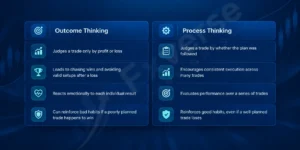
A well-planned trade can still lose money, and a poorly planned trade can still win. Process thinking accepts this and focuses on consistency rather than any single result.
Trading Plan and Trading Journal
A trading plan and a trading journal are the two practical tools that support process thinking.
A trading plan outlines a trader’s entry criteria, stop-loss rules, position sizing, and risk tolerance before any trade is placed. Having this written down in advance makes it harder to justify impulsive decisions in the moment.
A trading journal records what actually happened: the entry, the exit, the reasoning, and the emotional state during the trade. Over time, a journal reveals patterns, like a tendency to move stop-losses or enter trades out of boredom, that are difficult to notice otherwise.
Both tools work together with sound risk management practices, which govern how much capital is exposed on any single trade regardless of how confident a trader feels.
Practical Beginner Scenario
Consider a beginner trader who has a rule to risk no more than 1% of their account per trade. They enter a trade, and it moves against them.
Emotional response: Move the stop-loss further away, hoping the price will recover, since “it’s just a small dip.”
Process-driven response: Let the stop-loss execute as planned, record the trade in a journal, and review whether the entry criteria were actually met.
The second response might still result in a loss. But it keeps risk contained to the original 1% and preserves the integrity of the trading plan for the next trade.
Beginner Trading Discipline Checklist
Before placing a trade, a beginner can run through this checklist:
- Does this trade match my written entry criteria?
- Have I set a stop-loss before entering?
- Is my position size within my risk tolerance?
- Am I entering because of a valid setup, or because of FOMO?
- Am I trying to recover a previous loss with this trade?
- Will I record this trade in my journal regardless of the outcome?
Reviewing this list consistently, before entering a trade rather than after, is one of the simplest ways to build trading discipline over time.
Building Discipline Is an Ongoing Process
Trading psychology isn’t something a beginner masters once and moves past. Fear, greed, FOMO, and overconfidence resurface throughout a trader’s career, often in new forms as account size or market conditions change.
The traders who manage these emotions most effectively aren’t the ones who never feel them. They’re the ones who’ve built a plan, a journal, and a checklist that catch impulsive decisions before they become costly ones.
FAQ
Why is trading psychology important for beginners?
Beginners are especially vulnerable to emotional decision-making because they haven't yet built the experience or habits to recognize these patterns in real time. Understanding trading psychology early can prevent common, costly mistakes.
Can trading psychology be improved over time?
Yes. Keeping a trading journal, following a written trading plan, and reviewing past decisions are practical ways beginners can strengthen discipline and reduce emotional trading.
What is the difference between fear and loss aversion in trading?
Fear is a general emotional response to risk or uncertainty. Loss aversion is a more specific bias where the pain of a loss feels stronger than the satisfaction of an equivalent gain, which can cause traders to hold losing positions too long.


Leave A Comment