
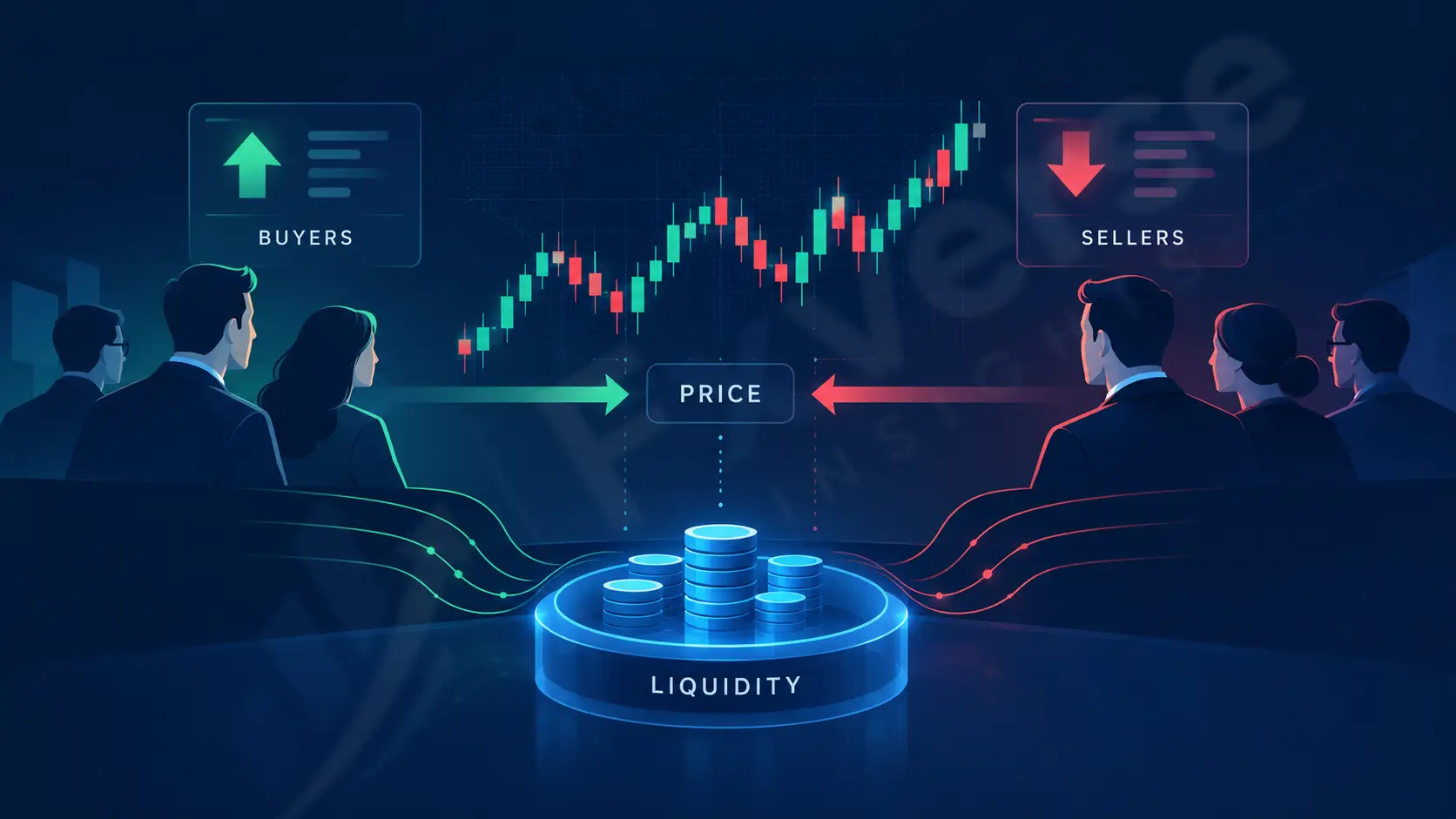
A financial market is a place—physical or digital—where buyers and sellers trade assets like stocks, currencies, bonds, and commodities. Prices are determined by the interaction of buy and sell orders. When more buyers enter the market than sellers, prices tend to rise. When sellers outnumber buyers, prices tend to fall.
If you’ve ever wondered why a stock price moves up and down, or how a currency exchange rate changes by the second, the answer comes down to a few core mechanics: buyers, sellers, orders, and liquidity. These aren’t advanced concepts reserved for professional traders—they’re the foundation of how every financial market operates.
This article breaks it all down in plain language. By the end, you’ll understand what a financial market actually is, how prices are formed, what bid and ask prices mean, and why liquidity matters more than most beginners realize. No jargon, no hype—just a clear explanation of how markets work from the ground up.
What Is a Financial Market?
A financial market is any system or place where buyers and sellers come together to trade financial assets. These markets can be physical locations, like the New York Stock Exchange (NYSE) on Wall Street, or entirely digital platforms accessible from a laptop or phone.
Financial markets cover a wide range of asset types:
- Stock markets – where shares of publicly listed companies are bought and sold (e.g., NYSE, NASDAQ)
- Forex markets – where currencies are exchanged (e.g., EUR/USD, GBP/JPY)
- Bond markets – where government and corporate debt instruments are traded
- Commodity markets – where raw materials like gold, oil, and wheat are traded
Each of these markets operates on the same fundamental principle: a price is discovered through the interaction of buyers and sellers. The market itself doesn’t set the price—participants do.
What Is the Basic Role of an Exchange and Broker?
Two key players make market access possible: exchanges and brokers.
An exchange is the organized marketplace where trading actually takes place. It provides the infrastructure—matching engines, order books, and price feeds—that allow buy and sell orders to be executed. The NYSE and the Chicago Mercantile Exchange (CME) are examples of well-known exchanges.
A broker is the intermediary that connects individual traders and investors to an exchange. When you open a trading account and place a buy order, your broker routes that order to the appropriate exchange or liquidity pool on your behalf. Brokers typically charge a commission or earn revenue through the spread (explained below).
Think of it this way: the exchange is the marketplace, and the broker is the door you walk through to get there.
What Are Bid and Ask Prices?
Every tradeable asset has two prices at any given moment: the bid and the ask.
- The bid price is the highest price a buyer is willing to pay for an asset.
- The ask price (also called the offer) is the lowest price a seller is willing to accept.
These two prices are never the same. The difference between them is called the spread.
Example: If the bid price for a stock is $99.95 and the ask price is $100.00, the spread is $0.05. If you buy at the market price, you pay $100.00. If you sell immediately, you receive $99.95. That $0.05 difference is the cost of transacting.
The spread represents a built-in cost of trading. In highly liquid markets, spreads tend to be narrow. In less liquid markets, spreads can be significantly wider.
Why Does Price Move?
Price moves because the balance between buyers and sellers is constantly shifting.
When more buyers want to purchase an asset than sellers are willing to sell it, demand exceeds supply. To attract sellers, buyers must offer higher prices—and the price rises. The reverse is also true: when sellers outnumber buyers, prices fall as sellers compete for available buyers.
This tug-of-war plays out continuously through the order book—a live record of all pending buy and sell orders at various price levels. When a large buy order comes in and exhausts the available sell orders at the current price, the next available sell orders are at a higher price. The price “moves up” to fill demand.
Buyers → Orders → Market → Price Discovery ← Orders ← Sellers
Price discovery is the process by which this interaction determines the current fair value of an asset. No single participant controls it—the price reflects the collective activity of everyone in the market at that moment.
A Practical Example of Supply and Demand
Here’s a simple example to make this concrete.
Imagine a stock is trading at $50.00. At that price, 1,000 shares are available for sale. Suddenly, strong earnings news is released, and buyers flood in wanting 5,000 shares—but only 1,000 are available at $50.00.
- The first 1,000 shares are bought at $50.00
- The next batch of sellers are asking $50.50—so the next 1,000 shares fill at $50.50
- Demand continues, and the price keeps moving up to $51.00, $51.50, and beyond
The price rose not because of a central authority deciding it should, but because demand outstripped supply at each price level. Buyers had to pay more to attract sellers. That’s supply and demand in action.
What Is Liquidity and How Are Orders Matched?
Liquidity refers to how easily an asset can be bought or sold without significantly affecting its price. A liquid market has many active buyers and sellers, plenty of available orders, and tight spreads. An illiquid market has fewer participants, wider spreads, and less predictable price behavior.
Order matching is handled by the exchange’s matching engine. When you place a market order (an instruction to buy or sell immediately at the best available price), the matching engine pairs your order with the best available opposing order in the order book.
- A market buy order matches with the lowest available ask
- A market sell order matches with the highest available bid
This happens in milliseconds on modern exchanges. For a deeper look at how liquidity affects your trading, read What Is Liquidity in Trading? A Simple Guide.
High-Liquidity vs. Low-Liquidity Markets: What’s the Difference?
Liquidity has a direct and measurable impact on how you experience a market as a trader. Here’s how the two scenarios compare:
|
Factor |
High Liquidity |
Low Liquidity |
|---|---|---|
|
Spread |
Generally narrower |
Generally wider |
|
Order Execution |
Usually easier |
Can be more difficult |
|
Slippage |
Generally lower |
Can be higher |
|
Price Impact |
Usually smaller |
Can be larger |
|
Price Movement |
Generally smoother |
Can be more abrupt |
High-liquidity example: You place a market order to buy 100 shares of Apple (AAPL). The order fills instantly at or very near the quoted price, with minimal slippage.
Low-liquidity example: You place a market order to buy shares in a small-cap company with low trading volume. There aren’t enough sellers at the current price, so your order fills across several price levels—each slightly higher than the last. The final average price is noticeably above what you expected.
Slippage is the term for this difference between the expected price and the actual fill price. It’s most common in low-liquidity conditions or when placing large orders in any market.
How Do News, Expectations, and Volatility Affect Markets?
Markets don’t only react to what’s happening right now—they also react to what participants expect to happen. This is why prices often move before a news announcement, not just after.
When economic data is released—jobs reports, central bank interest rate decisions, inflation figures—traders rapidly reassess the value of assets based on the new information. If the data is significantly different from expectations, the adjustment can be sharp and sudden.
Three common triggers for rapid price movement include:
- Unexpected news – A surprise earnings miss, geopolitical event, or policy change can shift sentiment instantly
- Shifts in expectations – If traders were pricing in a 0.25% rate cut and the central bank delivers 0.50%, the discrepancy drives fast repositioning
- Low liquidity combined with large orders – When a large order hits a thin market, it can move through multiple price levels quickly, creating a sharp spike or drop
These rapid movements are what traders refer to as volatility—the degree to which price fluctuates over a given period. Higher volatility means larger price swings, which brings both greater risk and greater opportunity. For a full explanation, see What Is Volatility in Trading? Risks and Opportunities Explained.
For those interested specifically in currency markets, the same mechanics apply—learn more in What Is Forex Trading? A Complete Beginner Guide.
Key Takeaways for Beginners
📌 Beginner Summary
Here are the core concepts to remember from this article:
- Financial markets are systems where buyers and sellers trade assets like stocks, currencies, bonds, and commodities
- Exchanges provide the infrastructure for trading; brokers give you access to exchanges
- Bid price = what a buyer will pay; Ask price = what a seller will accept; Spread = the difference between them
- Prices move because of imbalances between buying and selling pressure in the order book
- Supply and demand determine price: more buyers push prices up; more sellers push prices down
- Liquidity describes how easily an asset can be traded without impacting its price
- News and expectations can shift market sentiment rapidly, increasing volatility
Frequently Asked Questions
What are bid and ask prices?
The bid price is the highest price a buyer is currently willing to pay for an asset. The ask price is the lowest price a seller is currently willing to accept. The two prices are always slightly different—the gap between them is called the spread. When you buy at market price, you pay the ask. When you sell, you receive the bid. The spread is effectively a transaction cost built into every trade.
Why is liquidity important in trading?
Liquidity determines how easily you can enter or exit a position. In a liquid market, orders fill quickly at prices close to what you expect, spreads are narrow, and slippage is low. In an illiquid market, it can be harder to find a matching order, spreads widen, and your order may fill at a worse price than anticipated. For traders, poor liquidity can turn a good trade idea into an unprofitable one simply due to execution costs.
Why does a price suddenly jump or drop?
Sudden price moves typically happen when market conditions shift faster than participants can adjust. Common causes include unexpected news releases, large orders hitting a thin order book, a rapid change in market sentiment, or a significant gap between actual data and what was expected. Low liquidity amplifies these moves—when there aren't many orders available at each price level, a single large order can push the price through several levels at once.


Leave A Comment