
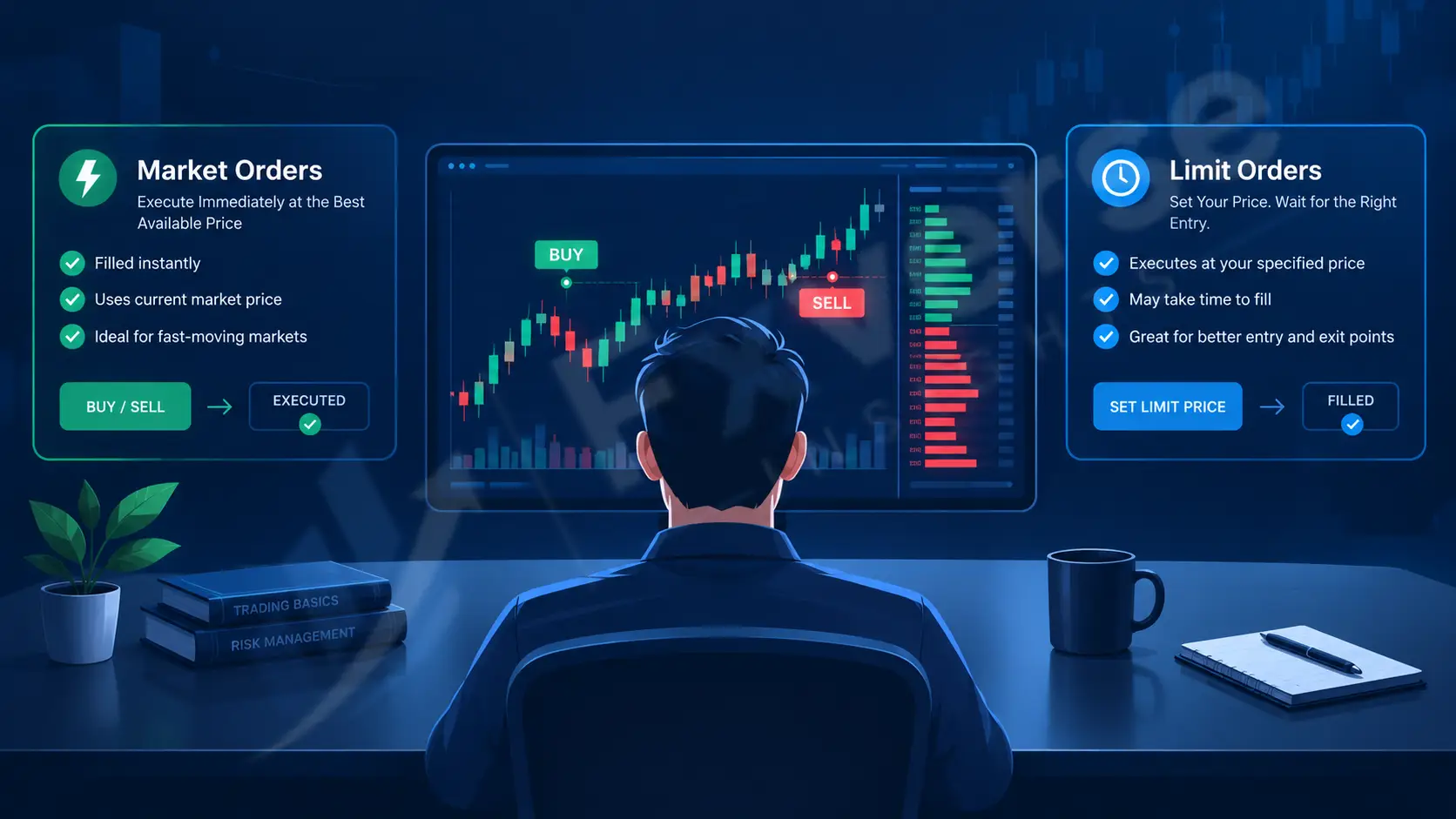
A market order buys or sells a currency pair immediately at the current price, prioritizing speed over price control. A limit order sets a specific price at which you’re willing to trade, prioritizing price control over speed. Beginners should use market orders for fast entry into liquid trades, and limit orders when precision and risk management matter more than immediate execution.
Every trade you place in the forex market starts with a decision most beginners don’t even realize they’re making: how should this order actually get filled? Two of the most common order types—market orders and limit orders—determine whether your trade executes instantly at the going rate or waits patiently for a price you’ve chosen.
Getting this choice right matters more than most new traders expect. Use the wrong order type at the wrong moment, and you could end up paying more than intended, missing a trade entirely, or getting caught in a price swing you didn’t see coming.
This guide breaks down exactly how market orders and limit orders work, when to use each one, and the common mistakes that trip up beginners. By the end, you’ll have a clear framework for choosing the right order type based on your trading goals.
What Is a Market Order in Forex Trading?
A market order is an instruction to buy or sell a currency pair immediately at the best available current price. Think of it like walking into a store and paying the sticker price without negotiating—you want the item now, and you’re willing to accept whatever the current price happens to be.
How Market Orders Function
When you place a market order, your trading platform matches you with the best available price in the order book at that exact moment. Because forex markets move quickly, the price you see when you click “buy” or “sell” may shift slightly by the time your order executes. This difference, known as slippage, tends to be minimal in highly liquid pairs like EUR/USD but can widen during volatile news events.
Advantages of Market Orders
- Speed: Your trade executes almost instantly, which matters when you need to enter or exit a position quickly.
- Simplicity: There’s no need to calculate or set a specific price—you just decide to buy or sell.
- Reliability in liquid markets: For major currency pairs with high trading volume, market orders typically fill at or very near the price you expect.
Disadvantages of Market Orders
- Price uncertainty: You don’t know the exact execution price until after the trade goes through, especially during volatile conditions.
- Slippage risk: In fast-moving markets, the final price can differ meaningfully from what you saw seconds earlier.
- Less control: You’re accepting the market’s terms rather than setting your own.
What Is a Limit Order in Forex Trading?
A limit order is an instruction to buy or sell a currency pair only at a specific price or better. Unlike a market order, a limit order won’t execute until the market reaches your chosen price—so you trade patience for precision.
How Limit Orders Function
Say you want to buy GBP/USD, but only if it drops to 1.2500. You place a limit order at that price. If the market reaches 1.2500 or lower, your order fills. If it never gets there, your order simply sits unfilled until you cancel it or it expires. Limit orders can also be used to sell at a price above the current market rate, letting you lock in gains at a target level automatically.
Advantages of Limit Orders
- Price control: You decide the exact price you’re willing to accept, removing the guesswork.
- No slippage on entry: Your order only executes at your specified price or better, protecting you from unfavorable fills.
- Useful for strategy automation: Limit orders let you set trades in advance and step away from the screen, which is ideal for traders managing multiple positions.
Disadvantages of Limit Orders
- No guarantee of execution: If the market never reaches your price, the trade never happens—even if the broader trend moves in your favor.
- Missed opportunities: Prices can move quickly, and a limit order that’s set too conservatively might mean watching a profitable move happen without you.
- Requires more market analysis: Setting an effective limit price means understanding support and resistance levels, not just clicking buy or sell.
Market Orders vs. Limit Orders: What Are the Key Differences?
The core difference between these two order types comes down to speed versus control:
|
Feature |
Market Order |
Limit Order |
|---|---|---|
|
Execution speed |
Immediate |
Only when price is reached |
|
Price certainty |
Low (subject to slippage) |
High (fixed price or better) |
|
Best for |
Fast-moving, liquid markets |
Planned entries and exits |
|
Risk |
Unexpected price movement |
Missed trade opportunities |
|
Control level |
Minimal |
High |
Choose a market order if getting into or out of a trade right now matters more than the exact price. Choose a limit order if hitting a specific price point matters more than trading immediately.
When Should You Use a Market Order vs. a Limit Order?
The right order type depends heavily on your trading style and the situation in front of you.
Use a market order when:
- You need to exit a losing position immediately to limit further damage.
- You’re trading a highly liquid pair like EUR/USD or USD/JPY, where price differences between orders are typically small.
- Speed matters more than getting the absolute best price, such as during breaking economic news.
Use a limit order when:
- You’ve identified a specific support or resistance level where you want to enter or exit.
- You’re not in a rush and prefer to wait for favorable pricing.
- You want to automate part of your strategy, setting orders in advance based on technical analysis.
Practical Examples: How Order Types Affect Trading Strategies
Consider a trader who believes EUR/USD, currently priced at 1.0850, will rise after an upcoming Federal Reserve announcement. If she wants to guarantee she’s in the trade before the announcement drops, she’d use a market order to buy immediately at 1.0850, accepting whatever minor slippage occurs.
Now consider a different trader who has studied EUR/USD’s chart and noticed the pair tends to bounce off 1.0800 as a support level. Rather than buying now, he places a limit order to buy at 1.0800. If the price dips to that level, his order fills automatically—and if it doesn’t, he avoids buying at a less favorable price.
Both traders are acting on the same currency pair but using different order types to match their specific strategy and risk tolerance.
Tips for Choosing the Right Order Type for Your Goals
- Match the order to your urgency. If you need in or out right away, lean toward market orders. If timing is flexible, limit orders often serve you better.
- Study liquidity before trading. Market orders on major pairs generally involve less slippage than on exotic or thinly traded pairs.
- Combine both order types. Many experienced traders use market orders to enter positions quickly and limit orders to set predetermined profit targets or exit points.
- Factor in volatility. During major news events, spreads can widen and slippage on market orders can increase significantly. In these moments, a limit order may offer more protection, even if it means missing a trade.
- Start small. As a beginner, practice both order types with smaller position sizes until you’re comfortable predicting how each behaves in live market conditions.
Common Pitfalls to Avoid
- Using a market order during high-impact news events. Volatility can cause significant slippage, leading to a much worse price than expected.
- Setting limit orders too far from the current price. An overly ambitious limit price may never get filled, causing you to miss a valid trading opportunity.
- Ignoring spread costs. Both order types are affected by the bid-ask spread, and failing to account for it can eat into your expected profit.
- Forgetting to cancel unfilled limit orders. Old limit orders can execute unexpectedly if the market circles back to that price later, catching you off guard.
- Overusing market orders out of impatience. New traders sometimes default to market orders simply because they’re quicker, even when a limit order would offer better control and pricing.
Building Confidence with Order Types
Market orders and limit orders each serve a distinct purpose in forex trading. Market orders prioritize speed and simplicity, making them useful when timing outweighs precision. Limit orders prioritize price control, rewarding patience with more predictable execution.
As you continue building your trading skills, practice using both order types in a demo account before committing real capital. Pay attention to how slippage affects your market orders and how often your limit orders actually get filled. Over time, you’ll develop an intuitive sense of which order type fits which situation—a skill that forms the foundation of sound trade execution.
Frequently Asked Questions
Is a market order or limit order better for beginners?
Neither is universally better—it depends on the situation. Beginners should use market orders for quick entries and exits in liquid pairs, and limit orders when they want to trade at a specific, pre-planned price.
Can a limit order fail to execute?
Yes. If the market never reaches your specified price, the limit order remains open until you cancel it or it expires, meaning the trade never happens.
Does slippage affect limit orders?
No, limit orders execute only at your specified price or better, which eliminates slippage on entry. However, this protection means the order might not fill at all if the market doesn't reach your price.
Can I use both market and limit orders in the same trading strategy?
Yes. Many traders use market orders to enter a position quickly and limit orders to set take-profit or exit levels in advance, combining speed and precision within a single strategy.


Leave A Comment