
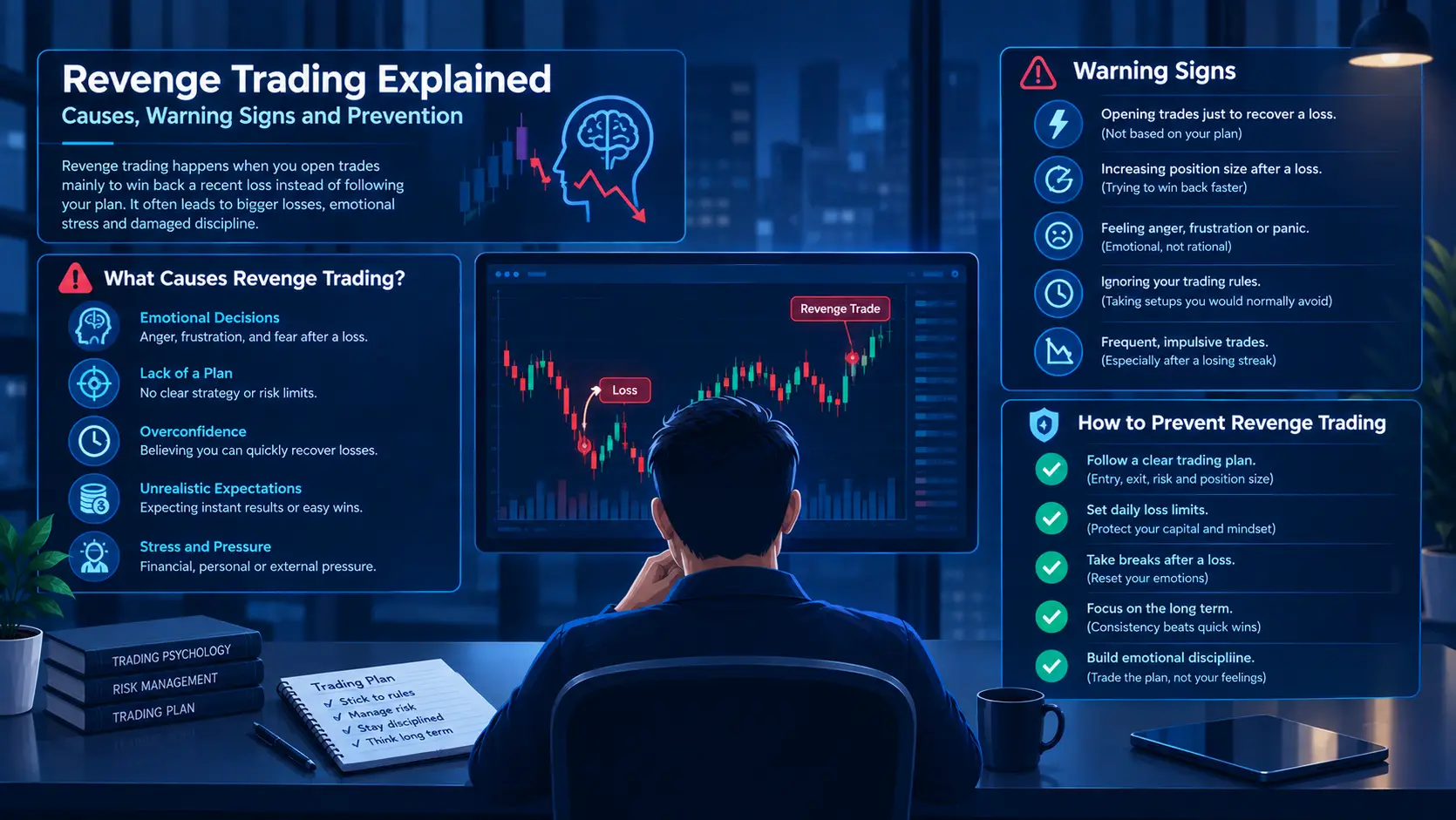
A losing trade is a normal part of trading. However, the decision that follows a loss can create a much larger problem when the goal shifts from following a strategy to getting money back quickly. Revenge trading is this emotionally driven attempt to recover a recent loss, often through larger positions, weaker setups, or decisions that would not normally fit the trading plan.
Importantly, revenge trading is defined by the motive behind the trade, not by whether the trade eventually wins or loses. A valid setup taken after a losing trade is not automatically revenge trading. Instead, the key question is whether the trader would have taken the same position if the previous loss had never happened.
In forex, fast order execution, leverage, and frequent trading opportunities can make an emotional reaction turn into a new position within seconds. Therefore, understanding the causes, warning signs, and prevention methods can help traders separate a normal losing streak from a destructive cycle of loss chasing.
What Is Revenge Trading?
Revenge trading is the practice of opening a new trade primarily to recover a recent loss rather than because a valid trading setup exists.
Typically, the trader becomes focused on returning to breakeven. As a result, position size, entry quality, risk limits, and trade selection can become secondary to emotional urgency.
The defining feature is motive, not outcome.
For example, suppose a trader loses on EUR/USD and then identifies another setup that completely satisfies the rules of their trading plan. Entering that trade does not automatically constitute revenge trading. The previous loss may have happened, but the new position is still based on an independent setup. By contrast, imagine the trader enters immediately because they are thinking, “I need to make that $100 back.” In that situation, the previous loss is influencing the decision. The trade may therefore be revenge-driven even if the chart happens to look reasonable.
A useful self-test is simple:
Would I still take this trade if the previous loss had never happened?
If the honest answer is no, pause before entering.
What Causes Revenge Trading?
Revenge trading usually develops from several factors working together. Loss aversion, frustration, anger, ego, and the desire to finish the day at breakeven can all contribute.
How Does Loss Aversion Influence Revenge Trading?
Loss aversion describes the tendency for losses to have a stronger psychological impact than comparable gains. Prospect theory, developed by Daniel Kahneman and Amos Tversky, showed that people evaluate outcomes relative to reference points and can behave differently when facing gains versus losses.
For a trader, that reference point may become the day’s starting balance or a recent account high. Consequently, a trader who starts the session with a loss may become increasingly focused on getting back to zero.
The popular idea that losses are always felt “twice as strongly” as equivalent gains should be treated cautiously. Estimates vary across studies, situations, and experimental designs. Therefore, it is more accurate to describe loss aversion as a well-studied behavioral tendency rather than a fixed numerical rule.
Why Does the Desire to Break Even Make Revenge Trading Worse?
Breakeven can become an emotional target even though it has no special significance for the next market setup.
For instance, a trader who is down $200 for the day may begin evaluating every opportunity according to one question: “Can this trade get me back to $0?” Instead of asking whether the setup meets the trading plan, the trader starts using the day’s P&L as the decision-making framework.
Research in behavioral finance has also examined a related break-even effect, where prior losses can influence willingness to take risks in an attempt to return to a previous reference point.
As a result, the desire to finish the day at breakeven can encourage decisions that would normally be rejected.
How Can Anger and Ego Contribute?
A losing trade can challenge a trader’s confidence, especially when the trader strongly believed the original analysis was correct.
In some cases, the trader begins treating the market as if it were an opponent that must be defeated. That mindset creates pressure to prove the original decision right or erase the loss immediately.
However, the market does not know about the previous trade. It also does not owe the trader a winning position after a loss.
Therefore, the next trade should be evaluated independently from the previous result.
Why Does Leverage Make Revenge Trading More Dangerous?
Leverage allows traders to control a larger position with a smaller amount of capital or margin. Consequently, increasing position size after a loss can make the financial impact of an emotional decision much larger.
The CFTC warns that leverage can amplify both gains and losses in retail forex trading and that traders can potentially lose all of their margin and, depending on the arrangement and jurisdiction, may face additional losses.
For revenge trading, the problem is not simply leverage itself. Instead, the danger appears when leverage is combined with emotional position sizing.
A trader who normally risks $100 might decide to risk $300 after a losing trade. If the second position also fails, the trader may increase the size again in an attempt to recover both losses.
Therefore, a relatively small planned loss can develop into a much larger drawdown within a single session.
What Are the Warning Signs of Revenge Trading?
Revenge trading often produces recognizable behavioral patterns. While one warning sign alone does not prove that a trade is revenge-driven, several signs appearing together should prompt a pause.
| Warning sign | What it may look like |
|---|---|
| Rapid re-entry | Opening another position shortly after a stop-out without fresh analysis |
| Size escalation | Increasing lot size specifically to recover the previous loss |
| Strategy drift | Taking setups outside the normal trading plan |
| Stop manipulation | Moving or removing a stop-loss because the trade is going against you |
| P&L fixation | Focusing on returning to breakeven instead of evaluating setup quality |
| Excessive trading | Opening more positions than planned after a losing trade |
| Emotional urgency | Feeling that another trade must be taken immediately |
| Chasing across pairs | Moving from one currency pair to another simply to recover money |
| Ignoring the checklist | Entering without completing the normal pre-trade process |
Physical or emotional cues can also appear before the order is placed. For example, a trader may notice tension, frustration, impatience, or an unusually strong urge to remain glued to the chart.
In practice, these feelings are not proof that a trade is invalid. Instead, they are signals to slow down and check whether the decision still follows the plan.
How Much Can Revenge Trading Cost a Forex Account?
The financial damage from revenge trading depends on position size, stop distance, pip value, leverage, and the number of trades involved. Therefore, the risk can be calculated before the order is placed.
Consider a hypothetical $10,000 account where the trader normally risks 1% per trade.
A trader enters EUR/USD with a 0.5-lot position and a 20-pip stop. Assuming a pip value of approximately $10 per standard lot, the position risks about $100 if the stop is reached.
That is a planned 1% loss.
Now imagine the trader becomes frustrated and immediately opens a 1.0-lot position with a 30-pip loss.
That second trade loses approximately $300.
Instead of accepting the original $100 loss, the trader has now lost approximately $400.
Suppose another emotional trade follows with 2.0 lots and a 25-pip loss. At roughly $20 per pip, that position loses another $500.
The combined damage becomes approximately $900, or 9% of the original $10,000 account.
At that point, recovering the drawdown requires more than a 9% gain because the remaining account balance is smaller. A $900 loss leaves $9,100, so recovering to $10,000 requires a gain of about 9.9% on the remaining balance.
This example is hypothetical and uses simplified pip-value assumptions. Actual results can differ because of spreads, commissions, execution conditions, slippage, and the specific currency pair.
The key lesson, however, is straightforward: oversizing after a loss can transform a controlled trading loss into a major drawdown very quickly.
How Can Traders Prevent Revenge Trading?
The most effective approach is to create rules before emotional pressure appears.
Once frustration takes control, relying entirely on willpower becomes difficult. Therefore, predefined constraints can reduce the number of decisions a trader has to make during an emotionally difficult period.
1. Set a Maximum Risk Per Trade
Choose a fixed risk level before entering the market.
For example, a trading plan might specify that every position risks the same predefined percentage or dollar amount. The exact figure should depend on the trader’s own strategy, account size, and risk tolerance rather than a universal formula.
Most importantly, the amount should not increase simply because the previous trade lost.
2. Create a Daily Loss Limit
A daily loss limit can prevent several emotional trades from turning into a much larger drawdown.
For instance, a trader can decide in advance that reaching a predetermined daily loss threshold means the trading session ends. The specific threshold is a personal risk-management decision, not a universally proven optimum.
Once the limit is reached, the important part is following the rule rather than negotiating with it.
3. Use a Cooling-Off Period
After a significant loss, step away from the trading screen.
A short break can interrupt the immediate emotional response and create space between the previous trade and the next decision. The exact duration can vary, but the rule should be established while calm rather than invented after the loss.
For example, a trading plan might require a 30-minute break after a stop-out that produces an unusually strong emotional reaction.
4. Use a Pre-Trade Checklist
A checklist creates a barrier between emotion and execution.
Before entering, verify:
- Does the setup meet the strategy rules?
- Is the entry clearly defined?
- Is the stop-loss placed at a logical level?
- Is the position size within the planned risk?
- Does the trade fit the permitted market and timeframe?
- Would I take this trade if my previous trade had been a winner?
- If the final answer is no, pause before entering.
5. Keep a Trading Journal
A trading journal turns emotional behavior into measurable data.
Record the entry, exit, position size, setup, risk, market conditions, and emotional state. In addition, tag trades that occur shortly after a loss.
After several weeks, compare those trades with the rest of the sample.
You may discover patterns such as:
- larger position sizes after losses
- lower-quality setups after stop-outs
- more trades during losing sessions
- repeated trading outside normal hours
- wider stops after losing positions.
The data can reveal whether a suspected behavior is actually occurring.
see our detailed [Trading Journal Guide].
6. Never Widen a Stop to Avoid Realizing a Loss
Moving a stop-loss farther away because a trade is losing can turn a planned risk into an undefined risk.
Instead, determine the stop level before entering and size the position around that risk.
If the setup fails, the loss is part of the trading process. Consequently, the trader can review the trade later without allowing the current position to dictate the next decision.
see our detailed [Position Sizing and Risk Per Trade].
Is Revenge Trading the Same as Averaging Down or Martingale?
No. These concepts can overlap, but they describe different things.
Revenge trading is primarily a behavioral pattern. The trader increases risk or takes additional positions because of an emotional desire to recover a loss.
Averaging down refers to adding to a position after price moves against it.
Martingale is a position-sizing approach in which the trader increases size after losses according to a predefined progression.
The important distinction is intention and planning.
For example, a trader may deliberately scale into a position while calculating the maximum total risk before the first entry. That is different from suddenly doubling the position because the previous trade produced a loss.
Similarly, increasing size after a losing trade does not create an obligation for the next trade to win. Probability does not remember the previous result.
Therefore, a trader should not interpret a loss as evidence that a larger position is now “due” to recover it.
Is Revenge Trading the Same as a Losing Streak?
No. A losing streak can occur even when a trader follows the strategy correctly.
Suppose a system has a valid setup, consistent position sizing, and predefined risk. Several losing trades can occur consecutively simply because individual outcomes contain uncertainty.
That situation is different from revenge trading.
A normal losing streak calls for reviewing the strategy and checking whether the system is operating within its expected parameters. Revenge trading, by comparison, involves abandoning or changing the process because of emotional pressure.
A trading journal can help distinguish the two.
Planned losses should generally show consistent risk, valid setups, and adherence to the trading plan. Revenge-driven losses may show rapid re-entry, escalating size, skipped analysis, or unusual trade selection.
What Should Traders Do After a Losing Trade?
The next trade should be treated as a new decision rather than as a mission to recover the previous loss.
First, accept the result of the completed trade. Next, step away if emotions are elevated. Then, review whether another setup genuinely meets the trading plan.
If a valid setup appears later, the trader can evaluate it on its own merits. Otherwise, there is no requirement to trade simply because the previous position lost.
This distinction is important because not trading is also a valid trading decision.
What Should Traders Remember About Revenge Trading?
Revenge trading is an emotional attempt to recover a recent loss rather than an independent decision based on a valid trading setup.
Its warning signs can include rapid re-entry, increasing position size, abandoning the trading plan, moving stop-losses, and becoming fixated on returning to breakeven.
However, a trade taken after a loss is not automatically a revenge trade. The defining question is whether the position would still make sense if the previous loss had never occurred.
Predefined risk limits, consistent position sizing, cooling-off periods, checklists, and honest journaling can reduce the opportunity for emotional decisions to escalate.
Most importantly, a loss should not determine the size, quality, or existence of the next trade.
Treat each position as an independent decision. Accept that losses are part of any strategy with uncertain outcomes. Then allow the trading plan, rather than the previous result, to determine what happens next.
Forex trading involves substantial risk, and leverage can amplify losses. The CFTC specifically warns that retail forex traders can lose substantial amounts and should understand the risks, counterparties, and protections associated with their trading arrangement.
This article is for educational purposes only and does not constitute financial advice.


Leave A Comment