

A forex currency pair shows the value of one currency against another, expressed as an exchange rate. The first currency listed is the base currency, and the second is the quote currency. For example, in EUR/USD, EUR is the base currency and USD is the quote currency, meaning the price reflects how many U.S. dollars are needed to buy one euro.
New traders often stumble over the same question when they first look at a trading platform: why is EUR/USD written that way, and what do the numbers actually mean? Forex currency pairs can look confusing at first glance, but the logic behind them is straightforward once you understand a few core terms.
This guide breaks down exactly what a currency pair is, how base and quote currencies work together, and how major, minor, and exotic pairs differ in liquidity and risk. By the end, you’ll be able to read any currency pair with confidence and understand why some pairs trade more smoothly than others.
What Is a Currency Pair?
What Is a Currency Pair?In the forex market, currencies are never traded in isolation. Instead, they’re always quoted in pairs because every trade involves buying one currency while simultaneously selling another. This structure reflects the relative value between two economies rather than an absolute price.
A currency pair typically looks like this: EUR/USD, GBP/JPY, or USD/CAD. Each pair consists of two three-letter currency codes separated by a slash. The order of these codes matters, since it determines which currency is being measured against the other.
Understanding forex currency pairs starts with recognizing the two distinct roles each currency plays: the base currency and the quote currency.
What Is the Base Currency?
The base currency is the first currency listed in a currency pair. It represents the currency you’re effectively buying or selling, and its value is always expressed as “1 unit” in the pair.
For instance, in USD/JPY, USD is the base currency. This means the exchange rate tells you how many Japanese yen are needed to purchase one U.S. dollar. Similarly, in GBP/USD, GBP is the base currency, so the quote reflects how many U.S. dollars it takes to buy one British pound.
The base currency essentially anchors the pair. Everything else in the quote is calculated relative to this single unit.
What Is the Quote Currency?
The quote currency is the second currency in the pair, and its value shows how much of that currency is needed to equal one unit of the base currency. In other words, the quote currency’s price fluctuates based on the base currency’s value.
For example, if GBP/USD is trading at 1.2500, this means one British pound is worth 1.25 U.S. dollars. As a result, if the exchange rate rises to 1.2600, the pound has strengthened against the dollar. On the other hand, if it falls to 1.2400, the pound has weakened.
This relationship between base and quote currency is the foundation of how forex currency pairs are read and interpreted.
EUR/USD Example: Reading a Currency Pair Step by Step
To make this concept concrete, consider the most heavily traded pair in the world: EUR/USD.
Suppose EUR/USD is quoted at 1.1000. Here’s how to break that down:
- EUR is the base currency, so it represents 1 unit.
- USD is the quote currency, showing the equivalent dollar value.
- Therefore, 1.1000 means it takes 1.10 U.S. dollars to buy 1 euro.
If the rate moves to 1.1050, the euro has become slightly more expensive relative to the dollar. In practice, traders watch these small movements, measured in pips, to assess currency strength. For a deeper explanation of these increments, see [What Is a Pip in Forex? Pip Value Explained With Examples].
This simple numerical example illustrates why understanding base and quote currency positioning matters before looking at more complex pair categories.
What Are Major Currency Pairs?
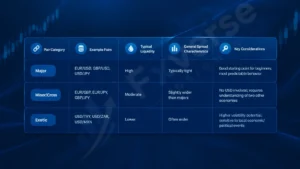
Major currency pairs are the most actively traded forex currency pairs in the global market. Each major pair includes the U.S. dollar alongside another highly traded currency from a large, stable economy.
The widely recognized major pairs include:
- EUR/USD (Euro/U.S. Dollar)
- GBP/USD (British Pound/U.S. Dollar)
- USD/JPY (U.S. Dollar/Japanese Yen)
- USD/CHF (U.S. Dollar/Swiss Franc)
- AUD/USD (Australian Dollar/U.S. Dollar)
- USD/CAD (U.S. Dollar/Canadian Dollar)
- NZD/USD (New Zealand Dollar/U.S. Dollar)
Because these pairs involve major global economies, they tend to have high trading volume. This high volume typically results in tighter spreads and more predictable execution, which is one reason many beginners start by learning these pairs first. For more foundational context, you may want to review [What Is Forex Trading? Complete Beginner Guide.
What Are Minor and Cross Currency Pairs?
Minor currency pairs, also called cross currency pairs, are pairs that don’t include the U.S. dollar at all. Instead, they pair two other major currencies directly against each other.
Common examples include:
- EUR/GBP (Euro/British Pound)
- EUR/JPY (Euro/Japanese Yen)
- GBP/JPY (British Pound/Japanese Yen)
Since these pairs skip the U.S. dollar, their exchange rates are calculated by comparing each currency’s value against the dollar and then deriving the cross rate. In contrast to major pairs, minors generally see lower trading volume. As a result, they may exhibit slightly wider spreads and marginally less liquidity, though this varies depending on market conditions and the specific pair.
What Are Exotic Currency Pairs?
Exotic currency pairs combine a major currency, often the U.S. dollar, with the currency of a smaller or emerging economy. Examples include:
- USD/TRY (U.S. Dollar/Turkish Lira)
- USD/ZAR (U.S. Dollar/South African Rand)
- USD/MXN (U.S. Dollar/Mexican Peso)
These pairs typically involve lower trading volume compared to majors and minors. Consequently, exotic pairs often come with wider spreads and can experience sharper price swings, particularly during periods of political or economic uncertainty in the smaller economy involved.
How Do Liquidity and Spreads Differ Across Pair Types?
Liquidity refers to how easily a currency pair can be bought or sold without significantly affecting its price. Generally speaking, major pairs offer the highest liquidity due to enormous daily trading volume, which helps keep spreads tight.
Minor pairs sit in the middle. They’re still reasonably liquid, but trading volume is noticeably lower than majors, so spreads tend to be a bit wider.
Exotic pairs, meanwhile, usually have the lowest liquidity among the three categories. This lower liquidity often results in the widest spreads and can make it more difficult to execute trades at expected prices, especially during volatile market conditions. To understand exactly how spreads translate into trading costs, see [What Is Spread in Forex? Bid, Ask and Trading Cost Explained].
What Risks Should Beginners Consider When Choosing a Currency Pair?
Selecting a currency pair isn’t just about picking one with the most price movement. Several factors affect the practical experience of trading a given pair, including volatility, liquidity, spread size, and overall trading costs.
Consider this hypothetical scenario: a new trader notices that USD/TRY has moved sharply over the past week and decides to trade it, hoping for a larger profit than a major pair might offer. However, because USD/TRY has lower liquidity, the spread is significantly wider than EUR/USD. As a result, the trader’s entry and exit prices are less favorable, and the trading cost eats into any potential gain. Meanwhile, unexpected news from the smaller economy could cause the price to swing even more sharply than anticipated.
This scenario highlights an important principle: a pair with big price swings isn’t automatically a better choice. In practice, beginners are often better served by starting with major pairs, where liquidity is higher and price behavior is generally more predictable, before gradually exploring minors and exotics as they build experience.
Summary Table: Major, Minor, and Exotic Currency Pairs
Beginner Checklist: Evaluating a Currency Pair
Before trading any forex currency pair, it helps to run through a simple checklist:
- Identify the base currency in the pair
- Identify the quote currency in the pair
- Understand what the current exchange rate represents
- Check the pair’s typical spread and liquidity
- Consider the pair’s historical volatility
- Understand the trading costs involved, including spread and any fees
- Avoid selecting a pair solely because it shows large price movements
Working through these steps consistently can help beginners build a more disciplined approach to evaluating forex currency pairs, rather than chasing volatility alone.
Building Confidence With Forex Currency Pairs
Understanding forex currency pairs comes down to grasping a few key relationships: how base and quote currencies interact, why majors tend to offer more liquidity than minors and exotics, and how spreads and volatility shift across categories. Once these basics feel familiar, reading any pair on a trading platform becomes far less intimidating.
As a next step, it’s worth exploring how pips and spreads directly affect trading costs, since these concepts build naturally on what you’ve learned here. Reviewing real-time quotes on a demo account can also help reinforce these ideas in a practical, risk-free setting.
Frequently Asked Questions
What are the major currency pairs?
The major currency pairs are EUR/USD, GBP/USD, USD/JPY, USD/CHF, AUD/USD, USD/CAD, and NZD/USD. These pairs all include the U.S. dollar and are known for high liquidity and generally tighter spreads.
Why are exotic pairs considered riskier?
Exotic pairs typically have lower trading volume, which often leads to wider spreads and increased sensitivity to political or economic events in the smaller economy involved. This combination can make price behavior less predictable than major pairs.
What is a cross currency pair?
A cross currency pair, also called a minor pair, is any pair that doesn't include the U.S. dollar. Examples include EUR/GBP and GBP/JPY, which measure two non-USD currencies directly against each other.
This content is for educational purposes only and does not constitute financial or investment advice.


Leave A Comment