

A pip in forex is the smallest standardized price movement a currency pair can make, typically the fourth decimal place (0.0001) for most pairs and the second decimal place (0.01) for JPY pairs. Pip value depends on the currency pair, trade size, and account currency. Understanding pips is essential for calculating profit, loss, and risk before placing any trade.
Every forex trader, no matter how experienced, learns to think in pips. It’s the common language used to describe price movement, measure profit and loss, and set risk parameters like stop-loss levels. Yet for beginners, the concept can feel oddly abstract at first glance.
This guide breaks down exactly what a pip in forex is, how it’s calculated, and why it matters more than most new traders initially realize. You’ll walk through real numerical examples, a simple calculation table, and a practical scenario that shows how pip value affects actual trading outcomes.
By the end, you’ll be able to calculate pip value for any pair, avoid the most common mistakes beginners make, and understand how pips connect directly to risk management.
Quick Answer: What Is a Pip in Forex?
A pip, short for “percentage in point,” is the standard unit used to measure price changes in the forex market. For most currency pairs, one pip equals a movement of 0.0001 in the exchange rate. For pairs involving the Japanese yen, one pip equals 0.01 due to the way yen pairs are quoted.
If EUR/USD moves from 1.1050 to 1.1051, that’s a one-pip movement. If USD/JPY moves from 110.50 to 110.51, that’s also a one-pip movement, just at a different decimal place.
What Is a Pip in Forex, Exactly?
A pip in forex represents the smallest standardized increment by which a currency pair’s price typically changes. It gives traders a consistent way to talk about price movement, regardless of which pair they’re trading.
Before pips became standardized, describing price changes across different currency pairs was inconsistent and confusing. Pips solved this by creating a uniform measurement, similar to how “degrees” standardize temperature readings regardless of the thermometer used.
It’s worth noting that pips aren’t the same as points or pipettes, a distinction covered in more detail later in this guide. For now, the key takeaway is that a pip is the reference unit traders use to describe how far a price has moved.
How Pips Work With Currency Prices
To understand how pips work, it helps to first understand how forex currency pairs are structured. Every pair consists of a base currency and a quote currency, and the exchange rate reflects how much of the quote currency is needed to buy one unit of the base currency. For a full breakdown of this relationship, see [Forex Currency Pairs Explained: Base, Quote, Majors, Minors and Exotics].
Most currency pairs are quoted to four decimal places. In these cases, one pip equals the fourth decimal place, or 0.0001. For example:
- EUR/USD moves from 1.0850 to 1.0851 → a one-pip move
- GBP/USD moves from 1.2600 to 1.2610 → a ten-pip move
Japanese yen pairs are the main exception. Because the yen has a much lower relative value per unit, JPY pairs are quoted to only two decimal places. As a result, one pip equals 0.01 rather than 0.0001. For example:
- USD/JPY moves from 149.50 to 149.51 → a one-pip move
This JPY-specific convention trips up many beginners, so it’s worth remembering as a standalone rule rather than assuming every pair behaves the same way.
How to Calculate Pip Value
Pip value refers to how much a single pip movement is worth in real currency, based on the size of your position. Calculating it accurately is essential, since it directly determines your profit or loss per pip of movement.
The general formula looks like this:
Pip Value = (One Pip / Exchange Rate) × Trade Size
However, the practical numbers differ depending on the pair and lot size. Standard lot sizes in forex are:
- Standard lot = 100,000 units of the base currency
- Mini lot = 10,000 units of the base currency
- Micro lot = 1,000 units of the base currency
Larger positions mean each pip is worth more in absolute currency terms, which is why position size is just as important as pip movement when evaluating potential outcomes. For more on this relationship, see [Position Sizing in Trading: A Beginner Formula With Examples].
Pip Value Examples: EUR/USD, USD/JPY, and Account Currency Conversion
Numbers make this concept far easier to grasp than formulas alone. Below are worked examples for a non-JPY pair and a JPY pair, using standard, mini, and micro lot sizes.
Example 1: EUR/USD (USD Account)
Assume EUR/USD is trading at 1.1000, and your account is denominated in U.S. dollars. Since USD is the quote currency, the pip value calculation is straightforward.
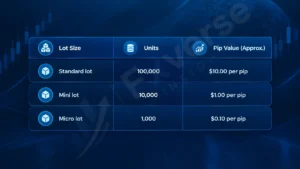
So, if you’re trading one standard lot of EUR/USD and the price moves 15 pips in your favor, that’s roughly a $150 gain. If it moves 15 pips against you, that’s a $150 loss.
Example 2: USD/JPY (USD Account)
Now consider USD/JPY trading at 150.00. Since JPY is the quote currency and pairs are quoted to two decimal places, the pip value calculation requires converting back into U.S. dollars.
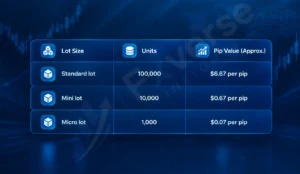
Notice that pip value for USD/JPY differs from EUR/USD, even though both trades might use the same lot size. This is exactly why assuming every pair carries the same pip value is a common and costly mistake.
Example 3: Account Currency Conversion
If your trading account isn’t denominated in U.S. dollars, an extra conversion step applies. For instance, a trader with a EUR-denominated account trading GBP/USD would need to convert the pip value from USD into EUR using the current EUR/USD exchange rate. Most trading platforms calculate this automatically, but understanding that the conversion exists helps explain why pip values can look slightly different across brokers or account types.
Pips, Profit, and Loss
Once you understand pip value, calculating profit and loss becomes a matter of simple multiplication: pip movement multiplied by pip value.
For example, suppose you open a one-mini-lot position on EUR/USD at 1.1000, and the price rises to 1.1050. That’s a 50-pip gain. At approximately $1.00 per pip for a mini lot, this trade would result in roughly a $50 profit, before accounting for spread or any broker fees.
The same logic applies in reverse. If the price had fallen to 1.0950 instead, that 50-pip move against your position would result in a comparable loss. This is why understanding pip value isn’t just theoretical, it directly reflects the real money at stake in every trade.
Pips and Risk Management
Pips aren’t only used to measure profit and loss after a trade closes. They’re also central to planning trades before you ever click “buy” or “sell.”
Consider this hypothetical scenario: a beginner trader plans to buy EUR/USD at 1.1000 and sets a stop-loss at 1.0970, a distance of 30 pips. Using the earlier pip value table, one mini lot means each pip is worth roughly $1.00. So, this trader is risking approximately $30 if the stop-loss is triggered.
By calculating pip distance and pip value together before entering the trade, this trader knows their maximum potential loss in advance, rather than discovering it after the fact. This proactive approach is a foundational part of sound trading discipline. To go deeper into structuring trades around acceptable risk levels, see [What Is Risk Management in Trading? Complete Beginner Guide].
Common Pip Calculation Mistakes
Even experienced traders occasionally slip up on pip-related calculations. Here are the mistakes beginners should watch for most closely:
- Confusing pips with points or pipettes. A pipette represents one-tenth of a pip and appears as a fifth decimal place on some platforms (or third, for JPY pairs). Points, meanwhile, are sometimes used loosely and inconsistently across different brokers.
- Using the wrong decimal place. Miscounting decimal places is one of the most frequent errors, particularly for traders switching between standard pairs and JPY pairs.
- Forgetting the JPY-pair convention. Since yen pairs use two decimal places instead of four, applying the standard pip formula without adjustment leads to inaccurate calculations.
- Assuming every pair has the same pip value. As shown in the EUR/USD and USD/JPY examples above, pip value varies by pair, exchange rate, and account currency.
- Ignoring position size. Pip movement alone doesn’t determine profit or loss, position size always factors into the equation.
- Forgetting account-currency conversion. Traders whose account currency differs from the quote currency need to factor in an additional conversion step for accurate pip value.
Avoiding these mistakes starts with slowing down and double-checking each calculation, especially when trading a new pair for the first time.
Beginner Summary Table: Pip Basics at a Glance
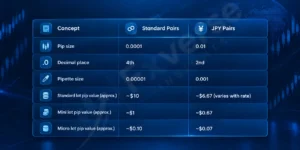
Beginner Checklist: Calculating Pip Value
Before calculating pip value or planning a trade, run through this checklist:
- Identify the currency pair you’re trading
- Check the correct decimal place for that pair (four decimals for most pairs, two for JPY pairs)
- Determine the pip size (0.0001 or 0.01)
- Identify your position size (standard, mini, or micro lot)
- Calculate and verify pip value using the pair’s exchange rate Consider your account currency and whether conversion applies
- Use pip distance when planning your risk and stop-loss levels
Working through this checklist consistently helps reduce calculation errors and builds a more disciplined approach to trade planning.
Frequently Asked Questions
How much is 1 pip worth?
Pip value depends on the currency pair, exchange rate, position size, and account currency. For a standard lot of EUR/USD, one pip is typically worth around $10; for a mini lot, around $1; and for a micro lot, around $0.10.
How do I calculate pip value?
Pip value is calculated using the formula: (one pip / exchange rate) × trade size. Most trading platforms calculate this automatically, but understanding the formula helps verify accuracy and plan trades with confidence.
How many pips is a 1% move?
This varies by currency pair and exchange rate, since a 1% move represents a percentage of the current price rather than a fixed pip count. For example, a 1% move on EUR/USD at 1.1000 equals roughly 110 pips, while the same 1% move on a different pair at a different exchange rate would translate to a different number of pips.
Are pips and pipettes the same?
No. A pipette is one-tenth of a pip. On platforms that quote to five decimal places (or three for JPY pairs), the fifth decimal represents the pipette, offering more precise pricing than the standard pip alone.
Putting Pip Knowledge Into Practice
Understanding what a pip in forex represents, and how to calculate its value, forms one of the most practical building blocks of trading knowledge. Once this concept feels familiar, connecting it to position sizing, spread costs, and risk management becomes far more intuitive.
As a next step, consider practicing pip calculations on a demo account using real-time quotes. Pairing this with a solid understanding of position sizing and risk management will help you approach live trading with greater confidence and discipline.
This content is for educational purposes only and does not constitute financial or investment advice.


Leave A Comment