
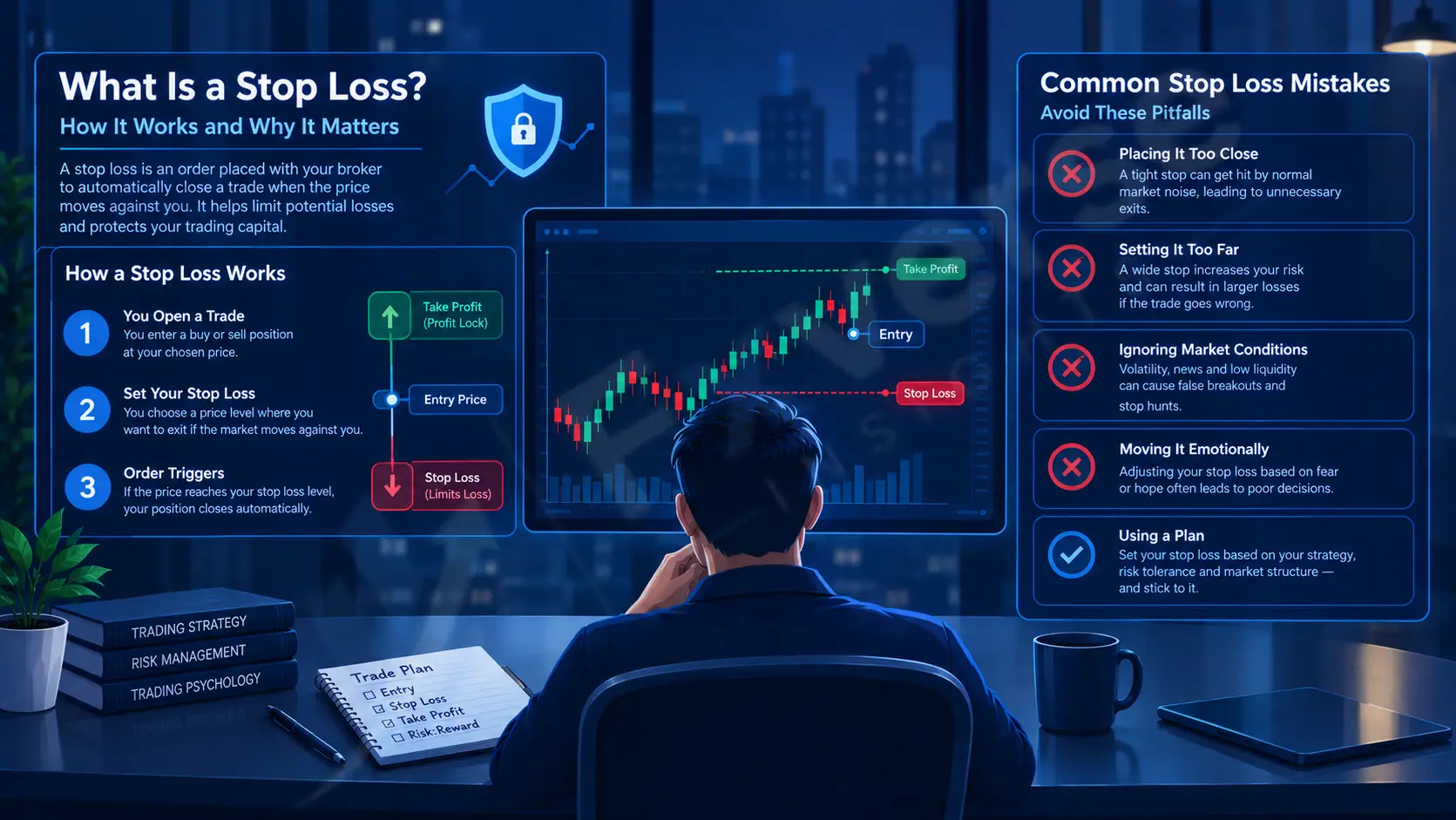
A stop loss is one of the most important risk-management tools in forex trading. It defines the price level where a trader intends to exit a position if the market moves against the original trade idea.
The important word is intends. A stop loss controls when the position will be closed, but it does not always guarantee the exact price at which the position will be closed. During fast markets, gaps, thin liquidity, or periods of wider spreads, the final execution price can differ from the stop level because of slippage.
In simple terms: a stop loss helps control planned risk by defining an exit point before a trade becomes a larger problem. It should be chosen alongside the trade’s invalidation level, volatility, position size, and account risk.
This guide explains how stop-loss orders work, where traders commonly place them, how stop distance affects position size, the different types of stops, and the mistakes that can undermine an otherwise sound risk-management plan.
What Is a Stop Loss in Forex Trading?
A stop loss is an order designed to close a trading position after the market reaches a predefined adverse price level.
For a long trade, the stop normally sits below the current market price. With a short trade, it normally sits above it.
For example, suppose a trader buys EUR/USD at 1.0850 and decides the trade idea would no longer be valid if price falls to 1.0800. The trader could place a stop loss at 1.0800.
The stop is not a prediction that EUR/USD will reach 1.0800. Instead, it defines a point where the trader has decided that remaining exposed to the position is no longer justified.
That makes a stop loss a risk-control tool rather than a forecasting tool.
It also means the stop should not be selected simply because a certain number of pips “looks safe.” Its location should have a logical connection to the trade.
Quick Answer: How Does a Stop Loss Work?
A conventional stop order remains inactive until its applicable trigger price is reached. Once triggered, it generally becomes an order to execute at the best available price under the broker or trading venue’s rules.
This creates an important distinction:
Stop price = trigger level
Execution price = actual price at which the position closes
These two prices can be different.
In calm and liquid market conditions, the difference may be small. During rapid price movements, gaps, or limited liquidity, however, the position may be filled at a worse price than the original stop level.
That difference is known as slippage.
Therefore, a standard stop loss can help limit planned exposure, but it should not be treated as a guaranteed maximum-loss price.
How Does a Stop-Loss Order Work in Practice?
Consider this example:
A trader buys EUR/USD at 1.0850 and places a stop loss at 1.0810.
The planned distance is:
1.0850 − 1.0810 = 0.0040 = 40 pips
If the relevant trigger price reaches 1.0810, the stop order is activated. Under normal market conditions, the resulting execution may occur close to that level.
But the position is not guaranteed to close at exactly 1.0810.
If price moves rapidly through the level, available liquidity changes, or the market gaps, the actual fill can be different.
This is why understanding the difference between triggering and execution is essential when using stop losses.
Bid, Ask, and Broker Rules Matter
Forex traders should also understand which price their broker uses when determining whether a stop has been triggered.
Depending on the platform and order type, triggering conventions can involve the bid, ask, or another price definition.
Broker specifications therefore matter. Traders should understand the exact order rules of the platform they use rather than assuming that every broker handles stop orders identically.
Why Do Traders Use Stop Losses?
The primary purpose of a stop loss is to establish a predefined exit condition before the trade is exposed to an uncontrolled adverse move.
Without a predefined exit, a losing position can become difficult to manage emotionally.
A trader may start thinking:
- “Maybe price will reverse.”
- “Perhaps I should give it a little more room.”
- “Moving the stop farther away might save the trade.”
- “I don’t want to close at a loss.”
A properly planned stop helps remove some of these decisions from the most stressful part of the trade.
However, the stop itself does not make a trading strategy profitable. It does not increase a trade’s win rate or guarantee a successful outcome.
Its purpose is much simpler:
It helps define how much exposure the trader is willing to maintain if the original trade idea fails.
Where Should You Place a Stop Loss?
A stop-loss level should reflect the reason the trade exists in the first place.
The key question is not:
“How many pips should my stop be?”
A better question is:
“At what price would my original trade idea no longer make sense?”
That point is often called the invalidation level.
Several approaches can help determine that level.
1. Market-Structure Stop Loss
A structure-based stop is placed beyond a meaningful price level that supports the trade thesis.
For a long trade, this could mean placing the stop below a relevant swing low or support area.
For a short trade, it could mean placing the stop above a relevant swing high or resistance area.
For example, if a trader buys EUR/USD because price is holding above a significant support zone, placing the stop below that zone can make more sense than choosing an arbitrary 20-pip distance.
If price breaks the level that originally justified the trade, the trade thesis may no longer be valid.
2. Volatility-Based Stop Loss
Another approach uses market volatility.
The Average True Range (ATR) is one commonly used volatility measure. ATR describes the typical range of price movement over a selected period; it does not predict whether price will rise or fall.
A trader might use an ATR multiple to establish a stop distance that adapts to current market conditions.
For example, a trader might use 1× ATR or 1.5× ATR as part of a predefined strategy.
The exact multiple is a strategy decision, not a universal rule.
A major advantage of volatility-based placement is that it can prevent traders from using the same fixed stop distance in very different market conditions.
3. Fixed-Pip Stop Loss
A fixed-pip stop is placed at a predetermined distance from the entry.
For example:
Entry: 1.0850
Stop: 1.0830
Distance: 20 pips
This approach is simple, but it can behave differently across currency pairs and market conditions.
A 20-pip stop may provide very different breathing room on EUR/USD compared with a more volatile pair or during a high-volatility news session.
For that reason, fixed distances should be evaluated within the context of the strategy and market conditions.
How Does Stop-Loss Distance Affect Position Size?
Stop distance and position size are closely connected.
A wider stop generally means a smaller position is needed to maintain the same planned monetary risk.
A narrower stop generally permits a larger position mathematically, although a very tight stop may make the trade more sensitive to normal market fluctuations.
A simplified relationship is:
Position Size = Chosen Monetary Risk ÷ Loss Per Unit at the Stop
The exact calculation depends on the currency pair, account currency, pip value, contract size, and broker specifications.
Simple Example
Suppose a trader decides the planned monetary risk on a trade is $100.
The stop is 50 pips away.
If the selected position has a pip value of approximately $2 per pip, the planned price-loss component is:
50 pips × $2 = $100
So the position size and stop distance are working together to define the planned risk.
If the trader instead wants to use a wider stop while keeping the same $100 risk budget, the position size generally needs to be reduced.
This is why choosing the lot size first and then forcing the stop to fit the position can reverse the normal risk-management process.
A more structured approach is:
Trade idea → invalidation level → stop distance → position size → planned risk
That sequence keeps the risk decision connected to the trade thesis.
What Are the Different Types of Stop Loss Orders?
The exact order types available depend on the broker and trading platform, but traders may encounter several forms of protective stops.
Standard Stop Loss
A standard stop is placed at a specific trigger level.
It generally remains fixed unless the trader or an automated strategy changes it.
Its main advantage is simplicity: the trader defines the level where the protective exit should be activated.
Its limitation is that the execution price is not necessarily guaranteed.
Trailing Stop Loss
A trailing stop is designed to move as price moves favorably.
For example, a trader might set a trailing distance that follows price upward during a long trade.
If price continues rising, the stop can move higher according to the trailing rules. If price then reverses enough to trigger the stop, the position can be closed.
Trailing stops can be useful in strategies designed to participate in trends while protecting some accumulated gains.
However, a trailing stop can also be triggered by a normal retracement if the trailing distance is too tight.
Guaranteed Stop Loss
Some brokers offer guaranteed stop products under specific terms.
These products are designed to provide execution at the specified stop level even when ordinary stop orders could experience slippage.
However, guaranteed stops are not universal features of every broker or platform, and they may involve additional costs, wider spreads, or specific eligibility rules.
Always check the broker’s exact terms before relying on a guaranteed-stop feature.
What Is the Difference Between a Stop Loss and a Stop-Limit Order?
A standard stop order and a stop-limit order handle execution differently.
A standard stop order prioritizes getting the position exited after the trigger is reached. Once activated, it generally becomes an order that seeks execution at the available market price under the relevant trading rules.
A stop-limit order activates a limit order instead.
This gives the trader more control over the acceptable execution price, but it creates another risk: the order may not execute at all if the market moves beyond the specified limit.
That distinction creates a fundamental trade-off:
Standard stop: greater emphasis on execution.
Stop-limit: greater emphasis on price control, with the possibility of non-execution.
For a protective exit, that difference matters. An unfilled stop-limit order can leave the original position open while price continues moving against it.
Because order functionality varies among brokers and platforms, traders should verify exactly which stop and stop-limit features are available.
What Are the Most Common Stop-Loss Mistakes?
Using a stop loss does not automatically mean a trader is managing risk correctly.
The way the stop is selected and managed matters.
1. Placing the Stop at an Arbitrary Distance
Choosing a stop simply because “20 pips is enough” ignores the structure and volatility of the market.
The stop should have a reason behind it.
2. Placing the Stop Too Close
A very tight stop can be triggered by ordinary market fluctuations before the trade has enough room to develop.
This is particularly relevant when the stop is placed inside the market’s normal volatility range.
A trader can be correct about the broader direction and still be stopped out if the stop does not allow enough room for normal price movement.
3. Moving the Stop Further Away
One of the most damaging habits is moving a protective stop farther away after price approaches it.
This changes the original risk calculation.
There may be legitimate trading strategies that adjust stops according to predefined rules. That is different from moving the stop impulsively because the trader does not want to accept the planned loss.
The key distinction is:
Rule-based adjustment ≠ emotional risk expansion
4. Choosing Position Size Before the Stop
If a trader chooses a lot size first and then moves the stop to accommodate that position, the risk framework can become distorted.
The stop should generally come from the trade’s invalidation logic, with position size adjusted to fit the intended risk.
5. Using a Mental Stop Instead of an Actual Order
A mental stop is simply a level the trader intends to exit manually.
The problem is that the decision must be executed at exactly the moment when the trade is moving against the trader.
That introduces execution and emotional risk.
When appropriate for the strategy and platform, using an actual protective order can make the predefined exit more systematic.
6. Ignoring Volatility and Liquidity
A stop that works reasonably well during normal market conditions may behave very differently during a major economic release or thin-liquidity period.
Market conditions matter.
7. Assuming the Stop Price Guarantees the Fill
This is one of the most important misconceptions.
A stop trigger is not necessarily the same as the final execution price.
Slippage can occur when the market moves quickly or available liquidity changes.
Can a Stop Loss Fail to Protect a Trade?
Yes.
A standard stop loss can fail to execute at its exact trigger price.
This does not mean the stop order itself necessarily “failed.” It means the market moved in a way that prevented execution at the precise level the trader originally selected.
Slippage
Slippage occurs when the actual execution price differs from the expected or requested price.
During normal, liquid conditions, slippage may be relatively small.
During fast markets, it can become more significant.
Gaps
A market gap occurs when price moves from one level to another without trading through all the prices in between.
If the market opens beyond a stop level, the position may be executed at the next available price rather than exactly at the stop.
Major Economic Announcements
Important economic releases can produce rapid price movements and changes in liquidity.
Unexpected geopolitical events can have similar effects.
Weekend Gaps
Forex markets are generally closed over the weekend. If a major event occurs while the market is closed, price can reopen at a materially different level.
A standing stop may therefore execute at a price significantly different from the stop trigger.
These conditions are why traders should understand that a stop loss manages planned risk but does not eliminate execution risk.
Can a Stop Loss Guarantee the Maximum Amount You Will Lose?
No—not with a standard stop loss.
A standard stop loss defines a trigger level, but the actual execution price can be affected by:
- slippage
- gaps
- liquidity
- rapid market movement
- spread conditions
- broker execution rules
As a result, the actual loss can be greater than the amount calculated purely from the distance between entry and stop.
Broker-specific guaranteed stops may provide different protection, but they operate under their own terms and conditions.
This is why position sizing should leave enough room for the realities of execution rather than treating the stop price as an absolute guarantee.
Does Leverage Affect Stop-Loss Risk?
Yes.
Leverage allows traders to control a larger position relative to the capital committed to the trade.
That can magnify both gains and losses.
A stop loss can define an intended exit point, but leverage does not make that risk disappear.
The more important question is how much of the trading account is exposed if the stop is triggered and how the position is sized relative to that risk.
This is another reason why stop placement and position sizing should be considered together.
What Is Stop Hunting?
The term stop hunting is often used when traders believe price has moved through an obvious stop-loss area before reversing.
Visible swing highs, swing lows, round numbers, and other widely watched levels can attract clusters of orders.
However, the fact that price moves through a visible level and then reverses does not by itself prove that someone deliberately manipulated the market to trigger stops.
Order clustering, liquidity conditions, and normal price movement can also produce these reactions.
Therefore, traders should distinguish between an observable price event and a claim about the motive behind it.
What Should Traders Remember About Stop Losses?
A stop loss is a risk-control instruction, not a guaranteed exit price and not a replacement for proper position sizing.
A sound stop-loss process connects several decisions:
Trade thesis → invalidation level → stop distance → position size → planned monetary risk
The stop should have a logical reason for being where it is.
Market structure can help identify invalidation levels. ATR and other volatility measures can help account for normal price movement. Position sizing can then be adjusted so that the planned monetary risk remains appropriate.
At the same time, traders should understand execution risk.
A standard stop can experience slippage. Gaps can cause worse fills. Broker rules can affect triggering and execution. A stop-limit order can introduce the risk of non-execution.
The objective is therefore not to avoid every losing trade.
The objective is to make sure that when a trade idea is wrong, the resulting loss is controlled within a broader risk-management framework.
Frequently Asked Questions About Stop Losses
How does a stop loss work?
A conventional stop order remains inactive until its trigger condition is reached. Once triggered, it generally becomes an order to execute at the available market price according to the broker's rules.
Can a stop loss guarantee the exact loss amount?
No. A standard stop loss does not guarantee the exact execution price. Slippage, gaps, liquidity conditions, and rapid price movements can cause the actual fill to differ from the stop level.
Where should I place my stop loss?
The stop should generally be placed at a level that represents invalidation of the trade idea. Traders may use market structure, volatility measures such as ATR, or predefined strategy rules.
Should I choose my lot size before my stop loss?
Generally, the trade's invalidation level should help determine the stop distance, after which position size can be adjusted to match the intended risk. Choosing the position size first can encourage traders to distort the stop simply to accommodate the desired exposure.
What is the difference between a stop loss and a stop-limit order?
A standard stop generally prioritizes execution after the trigger is reached, while a stop-limit order adds a limit price that restricts acceptable execution. The trade-off is that a stop-limit order may remain unfilled if the market moves beyond the specified limit.
Can a trailing stop be triggered by normal market movement?
Yes. If a trailing stop is placed too close to the current price, an ordinary retracement can trigger it even when the broader trade idea remains intact.
Key Takeaways
- A stop loss defines a predefined exit trigger for a trade moving against the original position.
- A stop price is not necessarily the same as the final execution price.
- Slippage and gaps can cause actual losses to differ from the planned amount.
- Stop placement should be connected to trade invalidation, market structure, volatility, or a predefined strategy.
- ATR measures volatility; it does not predict market direction.
- A wider stop generally requires a smaller position size if the trader wants to maintain the same planned monetary risk.
- Moving a stop farther away simply because price is approaching it can undermine the original risk plan.
- A trailing stop moves according to predefined rules but can be triggered by normal retracements.
- A stop-limit order provides greater price control but can introduce the risk of non-execution.
- A stop loss manages risk; it does not eliminate market or execution risk.
The most important principle is simple:
Do not choose a stop merely because a certain number of pips feels comfortable. Choose the level where the original trade idea is no longer valid, then size the position so the planned risk remains appropriate.
 Tags:
Tags:

Leave A Comment