
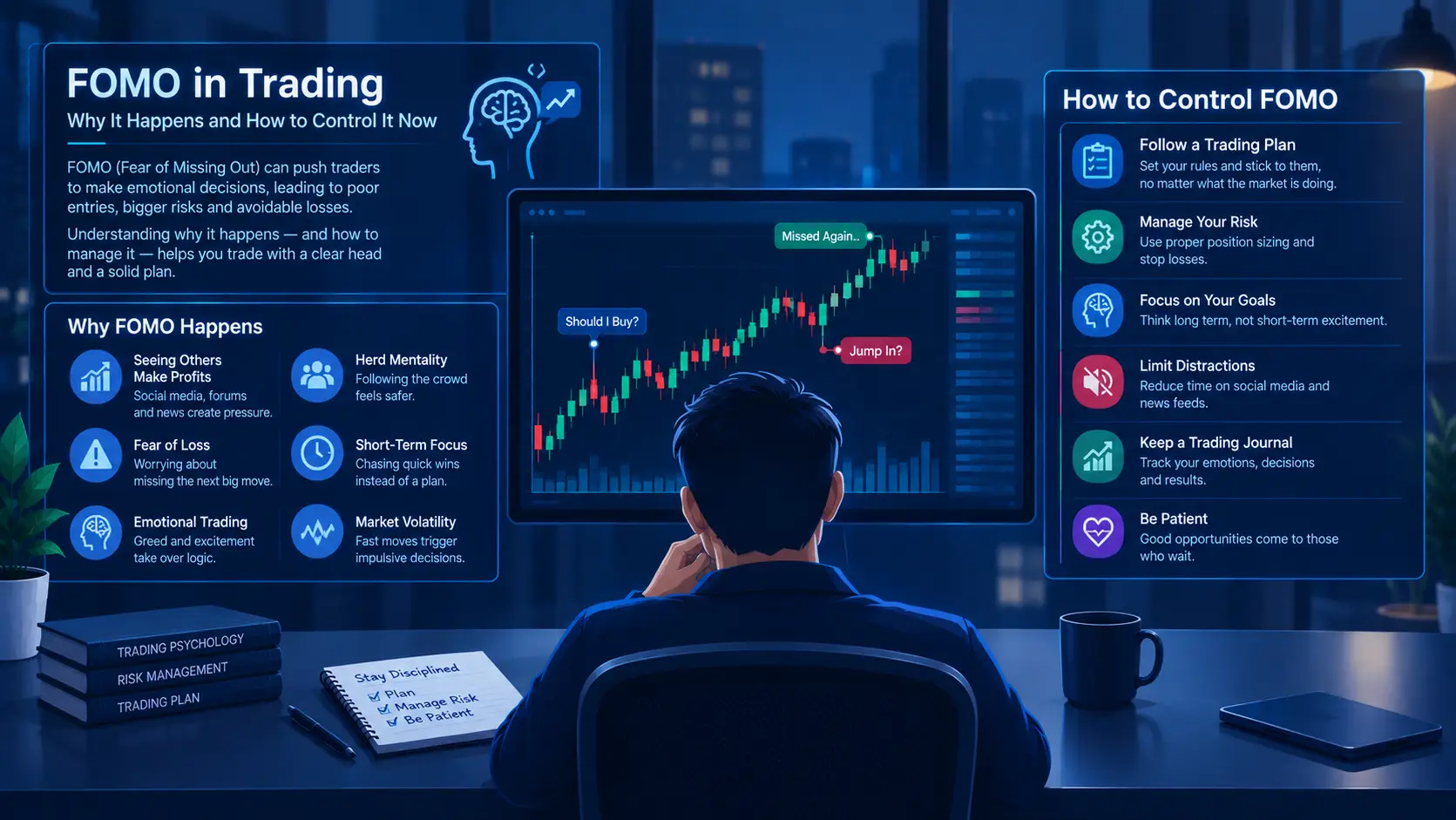
FOMO is not a beginner’s quirk. I have seen it hit disciplined traders after months of good process, usually after one missed breakout, one viral chart, or one public win they watched from the sidelines.
This article is educational. It is not personalized financial advice. Trading involves risk, and regulators such as FINRA warn that active day trading should not use retirement funds, emergency savings, student loans, or money needed for living expenses.
What does FOMO in trading actually mean?
FOMO in trading means entering, adding, or refusing to exit a position because a market move feels socially or financially urgent, not because a documented setup is valid. It usually appears when price accelerates, other traders display gains, and the trader treats a missed opportunity as a real loss.
The key word is “urgent.” A professional desk does not ask, “Is this moving?” It asks, “Is this my trade?”
FOMO starts when that second question disappears. The trader opens the order ticket before defining entry, stop, target, invalidation, and size.
Psychologists Andrew Przybylski, Kou Murayama, Cody DeHaan, and Valerie Gladwell helped formalize FOMO as a measurable construct in 2013, linking it to social media engagement and lower need satisfaction. Trading turns that social anxiety into a capital-allocation problem.
Why does FOMO happen when markets move fast?
FOMO happens because fast markets combine loss aversion, social comparison, attention bias, and uncertainty. The brain reads an unrealized gain as a missed reward, then searches for relief through action. Live feeds, screenshots, breaking news, and leaderboards intensify the signal by making other people’s apparent wins visible in real time.
Kahneman and Tversky’s prospect theory matters here because it explains why losses feel heavier than equivalent gains. A trader who missed a rally may feel punished, even though the account took no actual loss.
That false wound demands repair. So the next candle looks less like data and more like redemption.
Modern platforms make the loop faster. Alerts, watchlists, mobile notifications, Discord rooms, X posts, TradingView charts, and broker apps compress research, emotion, and execution into seconds. Speed helps prepared traders. It punishes reactive ones.
How can you spot a FOMO trade before entry?
You can spot FOMO before entry by looking for a break between the trade and the plan. Warning signs include rushed analysis, a late entry after an extended candle, larger size than normal, vague reasoning, ignored stop placement, and the phrase, “I have to get in now.”
Watch the language in your own head. “This is getting away from me” is not analysis. “Everyone is in this” is not confirmation.
The body often speaks first. OANDA flags racing heart, sweating, and urge-based thinking as practical signs of FOMO in trading decisions.
The ticket tells the truth. If you changed from a planned limit order to a market order because a candle expanded, you did not gain conviction. You lost process control.
What does FOMO do to risk, leverage, and performance?
FOMO damages risk by moving the entry while the target and invalidation level stay mostly unchanged. That compresses reward, widens practical stop distance, increases slippage exposure, and often triggers oversizing. In leveraged or margin products, the same emotional entry can create losses larger or faster than expected.
The arithmetic looks brutal. A planned entry at $50 with a $48 stop and $56 target risks $2 to make $6. That is 1:3.
Enter late at $55.50 and the target still sits at $56. Now the remaining reward is $0.50. If the logical stop is $53, the risk is $2.50. The trade becomes 1:0.2.
Barber and Odean’s Journal of Finance study of 66,465 household brokerage accounts found that the most active traders earned 11.4% annually while the market returned 17.9%. FOMO is not the only cause of excessive trading, but it feeds the same turnover problem.
Margin adds another layer. SEC Investor.gov warns that margin losses can mount quickly and that brokers may sell securities without prior notice.
How do you control FOMO before clicking buy or sell?
Traders control FOMO by removing discretion from the hottest seconds of the decision. The practical control stack is a pre-session plan, written entry criteria, fixed risk limits, a cooling period for unplanned trades, an execution checklist, and a post-trade journal that separates process quality from outcome.
Use a simple gate:
- Is this on my pre-session watchlist?
- Does it meet my setup rules?
- Is the stop technically valid?
- Is position size within risk limits?
- Does reward justify risk after the late entry?
- Would I take this trade if no one else could see it?
If one answer fails, stand down.
Build friction into the order ticket. Remove one-click trading. Use limit orders when appropriate. Set bracket orders only after defining stop and target. Add a five-minute delay for any trade that was not planned before the session.
The goal is not to become emotionless. That fantasy ruins traders. The goal is to make emotional trades operationally harder to place.
What should you do after a FOMO loss?
After a FOMO loss, the priority is interruption, not recovery. Stop trading long enough to record the trigger, the skipped rule, the entry quality, the position size, and the emotional state. Then compare that trade with planned trades over a statistically meaningful sample before changing strategy.
The worst response is “I’ll make it back.” That sentence often starts revenge trading.
Tag the trade in your journal as FOMO. Record the screenshot, entry, stop, target, R-multiple, trigger source, and missed rule. Then stop trading for the session if your rules require it.
Capital.com rightly notes that reviewing the sequence helps traders identify recurring triggers rather than making vague promises about discipline.
A good journal does not shame you. It prices your behavior. Once you see that FOMO trades consistently produce worse expectancy than planned trades, restraint stops feeling moral. It becomes statistical.
How should traders use social media without feeding FOMO?
Social media can inform traders, but it should not approve trades. Use it as a discovery layer only, then verify claims through primary filings, regulated market data, and your own setup rules. If a post creates urgency, anonymity, guaranteed-return language, or secret-access claims, treat it as a risk signal.
This is where trading psychology meets investor protection. SEC Investor.gov warns that stock recommendations on social media can be part of scams, and the CFTC warns that pump-and-dump schemes often use message boards, apps, and social platforms to hype thinly traded digital assets.
Place this inside the trading plan itself: [External citation placeholder: SEC Investor.gov — Social Media and Stock Tip Scams].
The professional habit is source hierarchy. Primary filings beat influencers. Regulated data beats screenshots. Your playbook beats crowd excitement.
FOMO never disappears. Markets will always move without you. The work is to miss bad trades cleanly, take valid trades calmly, and judge yourself by process before outcome.


Leave A Comment