
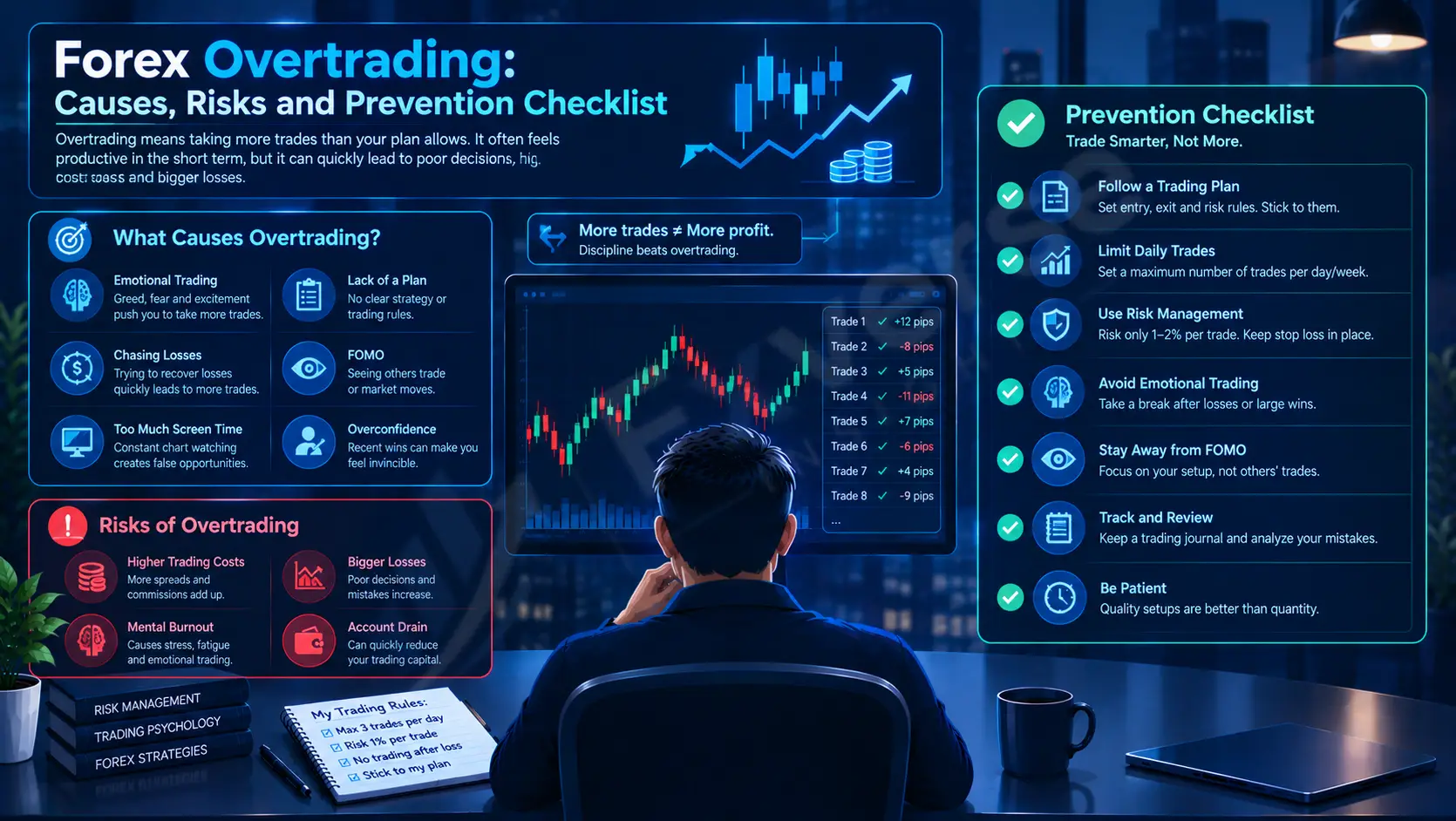
Overtrading in forex can gradually erode a trading account through unnecessary positions, repeated transaction costs, and decisions that fall outside a trader’s plan. A trader might close a losing EUR/USD position, immediately open another to recover the loss, and then enter a third trade without waiting for a valid setup. No single decision may seem significant, but repeated impulsive trades can undermine an otherwise structured approach.
The problem is not simply taking too many trades. It is taking trades—or using position sizes—that the trading plan and risk limits do not justify. A disciplined scalper may execute several trades in one session without overtrading, while a swing trader may overtrade after just a few unplanned entries.
This guide explains what overtrading means, why it happens, how it increases trading costs, and how a practical prevention checklist can help traders maintain discipline. It also includes a hypothetical EUR/USD spread-cost example to illustrate how trading frequency affects expenses.
What Is Overtrading in Forex?
Overtrading in forex occurs when a trader takes more positions or uses larger position sizes than their trading strategy, account risk limits, and predefined rules justify.
It generally takes two forms:
- Frequency overtrading: Taking additional trades that do not meet the strategy’s entry criteria.
- Size overtrading: Increasing position sizes beyond predefined risk limits, often to recover losses or pursue larger returns.
The defining feature is deviation from a plan, not the number of trades executed. A scalper taking 20 valid setups according to a tested strategy is not necessarily overtrading. A swing trader taking three unplanned positions in a quiet market may be.
Forex markets operate around the clock during the working week, giving traders frequent opportunities to monitor prices and open positions. However, constant access does not mean that every price movement offers a suitable trading opportunity.
A trading plan should establish when to enter, when to stay out, how much to risk, and when to stop trading.
What Causes Overtrading Among Forex Traders?
Overtrading often develops when emotional impulses combine with weak trading rules. Common triggers include fear of missing out (FOMO), revenge trading, boredom, overconfidence, and the absence of clearly defined entry and risk limits.
1. Revenge Trading After a Loss
Revenge trading occurs when a trader attempts to recover a previous loss through immediate or emotionally driven trades rather than waiting for the next valid setup.
For example, a trader risks $100 on a EUR/USD position and gets stopped out. Instead of accepting the loss, the trader immediately opens another position with twice the risk, hoping to recover the money quickly.
The second trade now risks $200 instead of the planned $100. If it also loses, the account suffers a larger drawdown, and the urge to recover the additional loss may trigger even more trades.
A losing trade does not automatically indicate that a strategy has failed. Even a valid setup can lose. The important distinction is whether the trader followed the predefined process.
If you want to understand this behaviour in more detail, see our guide to [Revenge Trading and How to Break the Cycle] to learn why traders try to recover losses emotionally and how predefined rules can help interrupt the pattern.
2. Fear of Missing Out (FOMO)
FOMO occurs when traders enter a market because they fear missing a price movement rather than because their strategy has generated a valid signal.
Suppose GBP/USD rises sharply during the London session. A trader who missed the initial move may enter late, hoping the price will continue rising. If the move has already weakened, the entry may offer an unfavourable risk-to-reward relationship.
Repeatedly chasing these movements can increase trade frequency without improving decision quality.
If you struggle with chasing price movements, see our guide to [Fear of Missing Out in Forex Trading] to understand how FOMO can influence entry decisions and why waiting for a valid setup matters.
3. Boredom During Quiet Sessions
Some traders feel that spending hours analysing charts should result in at least one trade. When prices move slowly, they may begin looking for setups that do not meet their strategy’s requirements.
This creates unnecessary exposure to market noise and increases the likelihood of impulsive decisions.
A period without a valid setup is not wasted time. Staying out of the market can be the correct decision when conditions do not meet a trading plan’s requirements.
4. Overconfidence After Winning Trades
A winning streak can encourage traders to believe that their market analysis is more reliable than it actually is.
They may begin taking weaker setups, increasing position sizes, or ignoring risk limits because recent results have increased their confidence.
However, a profitable trade does not prove that a decision was well-founded, just as a losing trade does not necessarily prove that it was poorly executed. Traders need to evaluate the quality of their decisions as well as their outcomes.
5. Lack of a Written Trading Plan
Without predefined rules, traders may make fresh decisions in response to every market movement.
A written plan should specify entry criteria, exit conditions, position sizing, acceptable trading sessions, and circumstances in which trading should stop. Without these boundaries, it becomes easier to justify unnecessary trades after the fact.
How Does Overtrading Differ From Active Trading?
Active trading and overtrading are not the same. Active trading involves frequent participation in the market, whereas overtrading involves exceeding a strategy’s justified frequency or risk limits.
| Active trading | Overtrading |
|---|---|
| Entries follow predefined rules. | Entries frequently fall outside the plan. |
| Trade frequency reflects the strategy. | Trade frequency increases without sufficient justification. |
| Position sizes follow risk limits. | Position sizes may increase impulsively. |
| The trader accepts periods without setups. | The trader feels compelled to participate. |
| Performance is reviewed systematically. | Decisions are often driven by immediate results or emotions. |
Consider two hypothetical EUR/USD traders.
Trader A is a scalper whose strategy generates several valid signals during a session. The trader follows the entry rules, calculates position sizes consistently, and stops when the predefined limits are reached.
Trader B follows a strategy that usually produces a few opportunities per session but begins taking additional trades whenever the market moves. After a loss, the trader increases position size to recover the money.
Trader A may be an active trader without overtrading. Trader B displays overtrading behaviour even if the total number of positions is lower.
The key distinction is not activity versus inactivity. It is rule-based execution versus unjustified trading.
What Are the Financial Risks of Overtrading?
Overtrading can increase transaction costs, weaken trade selection, increase cumulative market exposure, and make risk management more difficult.
1. Higher Spreads and Trading Costs
Forex trades incur costs that may include spreads, commissions, and slippage. Overnight positions may also incur swap charges or other financing adjustments.
The more frequently a trader completes trades, the more often these costs can accumulate. Even when individual costs appear small, their combined effect can become significant.
How Much Can Forex Spreads Cost Over Many Trades?
To understand how these costs work, see our guide to [Forex Spreads Explained] to learn how spreads are measured and how they can affect the cost of entering and exiting trades.
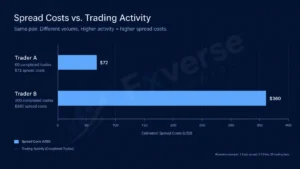
Consider a hypothetical USD-denominated account trading EUR/USD with the following assumptions:
- Account balance: $10,000
- Position size: 0.10 standard lots, equivalent to 10,000 currency units
- Assumed spread: 1.2 pips
- Approximate pip value: $1 per pip
- Trading period: 20 trading days
For this example, the estimated spread cost per completed trade is:
Spread cost = Spread in pips × Pip value
Therefore:
1.2 pips × $1 = $1.20 per completed trade.
The following table compares two hypothetical trading frequencies.
| Measure | Trader A | Trader B |
|---|---|---|
| Trades per day | 3 | 15 |
| Trades over 20 days | 60 | 300 |
| Estimated spread cost per trade | $1.20 | $1.20 |
| Total monthly spread cost | $72 | $360 |
| Cost as a share of $10,000 | 0.72% | 3.60% |
Trader B incurs $288 more in estimated spread costs over the period.
These figures are illustrative, not live broker quotes or a prediction of actual trading expenses. They assume the stated spread and position size remain constant and that each trade incurs one spread-equivalent cost. Actual costs vary with broker pricing, liquidity, execution, position size, and market conditions. Commissions, slippage, and overnight financing are excluded.
Higher trading frequency does not automatically mean worse results. The additional trades may be justified by a strategy. However, unnecessary trades must overcome their additional costs before they can contribute positively to net performance.
2. Larger Drawdowns and Excessive Exposure
Every additional position introduces potential market exposure. When traders open several positions in correlated currency pairs, their combined exposure may be greater than they realise.
For example, long positions in EUR/USD and GBP/USD may both be affected by a broad US dollar movement. These positions are not identical, but they can share an important source of risk.
Opening more trades without reviewing total exposure may therefore increase the amount at risk beyond the intended limit.
Leverage can magnify the effect of adverse price movements relative to the capital supporting a position. Depending on the account and broker’s terms, substantial losses can occur quickly.
3. Reduced Decision Quality
Frequent discretionary decisions can make it harder to maintain consistent standards. Traders may become less selective, overlook relevant market information, or abandon their original exit rules.
After several consecutive losses, frustration may influence the next decision. After a winning streak, excessive confidence may have the same effect.
A trading journal can help reveal whether these patterns are affecting execution.
If you are new to leverage, see our guide to [Forex Leverage Explained] to understand how leverage changes both capital requirements and potential losses.
How Can You Recognise the Signs of Overtrading?
The most reliable way to identify overtrading is to compare executed trades with the written trading plan and review the reasons behind each entry.
Common warning signs include:
Taking trades without a predefined setup. Entering positions immediately after losses to recover money. Increasing lot sizes outside established risk limits. Trading outside planned sessions without a strategy-based reason. Continuing to trade after reaching a daily loss limit. Feeling uncomfortable when no position is open. Accumulating transaction costs without a corresponding improvement in results. Being unable to explain why a trade met the entry criteria.
Trade count alone is not enough to diagnose overtrading. A high-frequency strategy may require many valid entries, while a slower strategy may generate only a few opportunities each week.
Instead, track the percentage of trades that complied with your rules. If the number of off-plan entries rises, investigate why before assuming the trading strategy itself is responsible.
What Is a Practical Forex Overtrading Prevention Checklist?
A prevention checklist turns general intentions into rules that can be checked before and during a trading session.
The goal is not to eliminate every losing trade. It is to reduce avoidable decisions and keep exposure within predefined boundaries.
Before Each Trading Session
1. Define the setups you will trade.
Write down the market conditions and entry signals your strategy requires. Avoid creating new criteria simply because a price movement looks attractive.
2. Select your trading sessions and currency pairs.
Focus on the pairs and periods your strategy is designed to trade. This can reduce unnecessary monitoring and impulsive entries.
3. Establish a maximum trade count if appropriate.
Use your trading records to determine a reasonable limit. A daily cap should reflect the strategy’s expected signal frequency rather than an arbitrary universal number.
4. Set a maximum daily loss.
Choose a limit appropriate to your account, strategy, and financial circumstances. Define in advance what happens when the limit is reached, including stopping new trades.
Before Every Entry
5. Confirm that the setup meets your rules.
Ask whether the trade satisfies the predefined entry criteria. If it does not, do not enter simply because the market is moving.
6. Calculate position size before placing the order.
Use the stop-loss distance, account currency, and acceptable monetary risk to determine position size. Do not increase the size simply to recover a previous loss.
If you need help calculating an appropriate trade size, see our guide to [Forex Position Sizing] to understand how account equity, risk per trade, and stop-loss distance influence position size.
7. Review total exposure.
Check existing positions and correlated currency pairs. A new trade can add risk even when its individual position size appears small.
8. Identify the reason for entering.
Ask yourself: “Would I take this trade if my previous trade had been profitable rather than a loss?” If the answer reveals that the main motivation is recovering money, pause and reassess.
After Trading
9. Take a break when your rules require one.
After consecutive losses, frustration, or a significant deviation from your plan, step away according to your predefined rules. A break is useful only if it prevents impulsive re-entry.
10. Record and review every trade.
Log the setup, entry reason, planned risk, result, and whether the trade followed your rules. Review the records weekly to identify recurring patterns.
These measures do not guarantee profitable trading. Their purpose is to make trading decisions more consistent, limit avoidable exposure, and help traders evaluate their process objectively.
Should You Set a Maximum Number of Trades Per Day?
A maximum trade count can help prevent impulsive entries, but the appropriate limit depends on the trading strategy and the quality of its signals.
For example, a trader whose documented strategy typically produces two to four valid setups per session may use a cap to discourage unnecessary additional entries. A scalping strategy may generate more signals and require a different limit.
The important point is to base the rule on the strategy’s requirements and historical records rather than assuming that fewer trades are always better.
A trade cap should also work alongside position-sizing rules and daily loss limits. It cannot prevent excessive exposure if the trader simply increases the size of each position.
How Does a Trading Journal Help Prevent Overtrading?
A trading journal records what happened, why a position was opened, and whether the decision followed the trading plan.
Over time, it can reveal patterns that are difficult to recognise during a live session. For example, a trader might discover that unplanned entries frequently occur after a stop-loss, during quiet market conditions, or after a profitable streak.
Useful journal fields include:
- Currency pair and trading session.
- Entry and exit reasons.
- Position size and planned risk.
- Whether the trade met the strategy’s criteria.
- Emotional state before entry.
- Transaction costs and net result, where available.
- Any deviation from the trading plan.
Review both compliant and non-compliant trades. A valid trade can lose, and an impulsive trade can win by chance. The objective is to determine whether decisions followed a repeatable process, not to judge every trade solely by its outcome.
Common Misconceptions About Forex Overtrading
“Overtrading simply means taking too many trades.”
Not necessarily. The relevant question is whether trade frequency and position size are justified by the strategy and risk limits.
“Every losing day means I have overtraded.”
A trader can follow a valid plan and still finish a session with losses. Evaluate process compliance separately from the financial outcome.
“More trades will recover my losses faster.”
Additional trades introduce further costs and market risk. There is no guarantee that they will recover previous losses.
“Experienced traders cannot overtrade.”
Experience can improve decision-making, but it does not remove the possibility of emotional or undisciplined behaviour.
“Trading less always improves profitability.”
Reducing unnecessary trades may lower costs, but skipping valid setups can also harm a strategy. The objective is appropriate execution, not the lowest possible trade count.
Frequently Asked Questions
Final Thoughts
Final Thoughts Forex overtrading is not defined by a universal number of trades. It occurs when trading frequency, position size, or exposure exceeds what a strategy and its risk rules justify.
Revenge trading, FOMO, boredom, and overconfidence can all encourage unnecessary activity. Repeated trades can also increase spreads and other costs, while excessive exposure can make drawdowns more difficult to manage.
A written trading plan, predefined risk limits, a practical pre-entry checklist, and a regularly reviewed trading journal can help traders identify and reduce these behaviours. None guarantees profits, but each makes it easier to distinguish planned decisions from impulsive ones.
The objective is not to trade as little as possible. It is to take trades for a valid, documented reason and keep risk within predefined limits.


Leave A Comment