
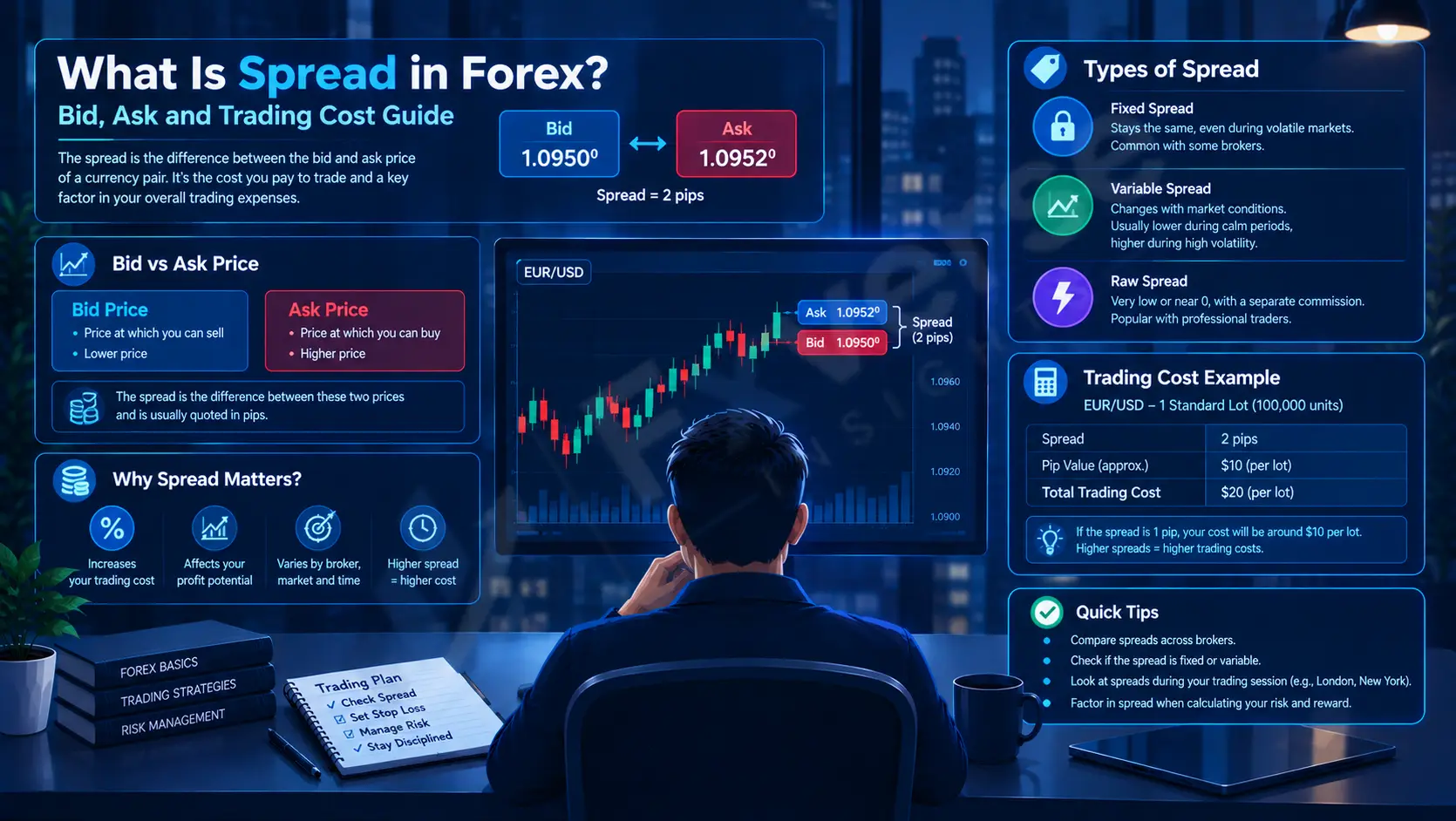
Every forex quote shows two prices: a bid and an ask. The difference between them is called the spread, and it is one of the main transaction costs a trader encounters when entering and exiting a position.
Understanding the spread helps explain why a newly opened trade can immediately show a small unrealised loss, why trading costs differ between currency pairs and brokers, and why spreads can change during volatile or low-liquidity periods.
This guide explains what the forex spread means, how bid and ask prices work, how to calculate spread costs, why spreads widen or narrow, and how spread fits into the broader cost of trading. All numerical examples are hypothetical unless stated otherwise.
What Is the Spread in Forex?
The spread in forex is the difference between a currency pair’s bid price and ask price.
The bid is the price at which a trader can sell the currency pair, while the ask is the price at which a trader can buy it. Because the ask is normally higher than the bid, the difference between the two prices represents the spread.
The basic formula is:
Spread = Ask Price − Bid Price
For example, suppose EUR/USD is quoted at:
1.0850 / 1.0852
The bid is 1.0850 and the ask is 1.0852. The difference is 0.0002, which equals 2 pips for a standard four-decimal EUR/USD quote.
The spread is part of the transaction cost rather than a separate fee that necessarily appears as a commission. Depending on the broker and account structure, trading costs may also include commissions, overnight financing or swap charges, slippage, and currency-conversion costs.
How Do Bid and Ask Prices Work?
Forex quotes are normally displayed with the bid first and ask second.
For example:
| EUR/USD Quote | Price |
|---|---|
| Bid | 1.0850 |
| Ask | 1.0852 |
| Spread | 2 pips |
If a trader opens a buy position, the position is opened at the ask price of 1.0852.
If a trader opens a sell position, the position is opened at the bid price of 1.0850. This difference can be confusing because trading platforms often display the bid price as the primary chart line. A trader may therefore see the market appear to be at one price while an order actually executes at the other side of the quote.
For a long position, the trade is generally opened at the ask and closed at the bid. For a short position, it is generally opened at the bid and closed at the ask.
This is also why a newly opened position can immediately show an unrealised loss. The market has not necessarily moved against the trader; the position is simply being valued against the opposite side of the bid-ask quote.
How Is Forex Spread Calculated?
The spread itself is calculated by subtracting the bid from the ask:
Spread = Ask − Bid
For EUR/USD:
1.0852 − 1.0850 = 0.0002
That equals 2 pips.
Many brokers now quote currency pairs with five decimal places, such as:
EUR/USD: 1.08502 / 1.08512
The difference is:
0.00010 = 1 pip
The extra decimal is commonly called a fractional pip or pipette. Traders should check the quote convention used by their platform rather than assuming every decimal represents a full pip.
For yen-based pairs, the standard pip position is different. For example, a USD/JPY quote of 150.00 / 150.02 represents a 2-pip spread because the pip is normally measured to the second decimal place.
For a deeper explanation of how pips work, see our guide to [what is a pip in forex].
How Much Does Forex Spread Cost?
Knowing the spread in pips is only part of the calculation. The actual dollar cost depends on pip value and position size.
A simplified formula is:
Spread Cost = Spread in Pips × Pip Value × Number of Lots
For EUR/USD, assuming a USD-denominated account, one standard lot of 100,000 units has a pip value of approximately $10.
Therefore:
2 pips × $10 = approximately $20
The same 2-pip spread would produce a smaller monetary cost on a smaller position.
| Hypothetical EUR/USD Quote | Spread | Position | Approx. Spread Cost* |
|---|---|---|---|
| 1.0850 / 1.0852 | 2 pips | 1.00 lot | $20 |
| 1.0850 / 1.0852 | 2 pips | 0.10 lot | $2 |
| 1.0850 / 1.0852 | 2 pips | 0.01 lot | $0.20 |
*Assumes EUR/USD and a USD-denominated account with an approximately $10 pip value per standard lot.
For other currency pairs, pip value can change with the exchange rate and the currency in which the trading account is denominated. That is why traders should calculate pip value rather than assuming that every pair has the same dollar cost per pip.
If you want to go deeper into how trade size affects risk, see our guide to [position sizing in trading].
Why Do Forex Spreads Widen and Narrow?
Forex spreads are not always fixed at one number. On variable-spread pricing, the gap between bid and ask can change as market conditions change.
Spreads generally become tighter when liquidity is deeper and trading activity is strong. They can widen when liquidity becomes thinner or uncertainty and volatility increase.
Common situations where spreads may widen include:
- Major economic announcements
- Central-bank interest-rate decisions
- Employment and inflation reports
- Market rollover periods
- Weekend market reopening
- Thin trading conditions
- Sudden geopolitical or financial-market shocks
Liquidity is an important part of this process. When many market participants are actively quoting prices, competing orders can support tighter spreads. When fewer participants are willing to provide liquidity, the available bid and ask prices can move farther apart.
The global scale of the forex market also changes throughout the day. The Bank for International Settlements reported approximately $9.6 trillion in average daily OTC foreign-exchange turnover in April 2025. However, that activity is not distributed evenly across every currency pair or every hour of the trading day.
For retail traders, the practical lesson is simple: a spread seen during a quiet period may not be the spread available during a major news release.
Why Do Different Currency Pairs Have Different Spreads?
Currency pairs do not all have the same level of liquidity.
Major pairs such as EUR/USD generally have deep trading activity and can have relatively tight spreads under normal market conditions. Less actively traded pairs may have wider spreads because there may be fewer competitive quotes available.
However, there is no single “normal spread” that applies to every broker or every trading session.
Spread can depend on:
- Currency pair
- Broker or dealer
- Account type
- Liquidity conditions
- Trading session
- Market volatility
- Economic news
- Position size and execution conditions
For that reason, a broker advertising a minimum spread of 0.0 pips does not mean a trader will consistently receive a 0.0-pip spread.
A more useful comparison is the typical spread during the hours and currency pairs a trader actually uses.
For beginners who want to understand how different pairs are structured and quoted, see our guide to [forex currency pairs].
Is Spread the Only Cost of Trading Forex?
No.
The spread is an important trading cost, but it is not necessarily the only one.
Depending on the account and broker, total trading costs may include:
- Spread — the difference between bid and ask.
- Commission — a separate charge that may apply to certain account types.
- Swap or overnight financing — a charge or credit associated with holding certain positions overnight.
- Slippage — the difference between an expected execution price and the actual filled price.
- Currency conversion fees — potentially relevant when the account currency differs from the currency involved in a transaction.
This distinction matters when comparing account types.
For example, imagine two hypothetical EUR/USD accounts:
Account A
Spread: 1.2 pips Commission: $0
Assuming a $10 pip value:
1.2 × $10 = $12
Account B
Spread: 0.2 pips Round-turn commission: $6
Spread cost:
0.2 × $10 = $2
Total:
$2 + $6 = $8
In this simplified example, Account B has the lower transaction cost for that particular trade size. But actual costs depend on the broker’s pricing, spread conditions, commission schedule, execution and other charges.
The important point is that a low advertised spread does not automatically mean a lower overall trading cost.
How Does Spread Affect Different Trading Styles?
Spread matters differently depending on how frequently a trader trades and how large each expected price movement is.
For a scalper targeting relatively small price movements, even a small spread can consume a meaningful percentage of the expected move.
Suppose a strategy targets a 10-pip move and the spread is 1.5 pips.
The spread represents:
1.5 ÷ 10 × 100 = 15%
of the target distance.
Now compare that with a 50-pip target:
1.5 ÷ 50 × 100 = 3%
The same spread has a much smaller relative effect.
Trading frequency matters as well. If a trader makes 20 hypothetical round trips on one standard lot and the relevant spread averages 1.5 pips, the spread component alone would be approximately:
20 × 1.5 × $10 = $300
This does not mean the strategy is profitable or unprofitable. It simply demonstrates how transaction costs accumulate when trading frequency increases.
For longer-term traders, spread may represent a smaller proportion of the expected price movement, although overnight financing and other costs can become more relevant.
What Is the Difference Between Fixed and Variable Spreads?
A fixed spread is designed to remain within a specified or relatively stable range under normal conditions.
A variable spread changes according to market conditions. It may become narrower during periods of strong liquidity and wider during periods of volatility or reduced liquidity.
Neither description should be treated as a guarantee of a particular execution outcome.
For example, a variable spread may become significantly wider around a major economic announcement. A fixed-spread account may offer more predictable quoted pricing under normal conditions but can have other pricing or execution conditions that traders should understand.
When comparing accounts, traders should examine the complete pricing and execution terms rather than looking only at whether the spread is labeled “fixed,” “variable,” “raw,” or “zero.”
What Is a Zero-Spread Forex Account?
A “zero-spread” account does not necessarily mean zero trading costs.
Some account structures advertise very low or zero spreads while charging a separate commission. In that situation, the commission is part of the total cost of executing the trade.
For example, a hypothetical account might offer:
0.1-pip spread + $7 round-turn commission
while another account might offer:
1.2-pip spread + $0 commission
Neither headline figure is enough to determine the total cost.
The correct comparison is the all-in cost for the actual position size and currency pair being traded.
What Do Traders Commonly Get Wrong About Forex Spreads?
1. “Zero spread means free trading.”
It doesn’t. A broker can charge a commission instead of building the full cost into the spread.
2. “The advertised spread is what I will always receive.”
Minimum or “from” spreads represent a particular pricing condition. Actual spreads can change with liquidity and volatility.
3. “The spread is only relevant when opening a trade.”
The bid and ask prices affect both entry and exit. The spread can also change between the time a position is opened and closed.
4. “A tighter spread automatically means a better broker.”
Not necessarily. Traders should consider commissions, execution, slippage, swap charges, regulation, and other account conditions alongside the spread.
5. “The chart price is always the price at which my order will execute.”
Many platforms display the bid price as the primary chart line. Depending on the order type and direction, execution can occur on either side of the quote.
6. “A wider spread always means the broker is manipulating prices.”
A wider spread can occur because of genuine changes in liquidity, volatility, market conditions or the broker’s pricing model. Traders should examine the broker’s documented pricing and execution conditions rather than assuming a cause without evidence.
How Can Traders Manage the Impact of Spread?
Traders cannot eliminate the bid-ask spread from normal market execution, but they can account for it when planning trades.
Useful practices include:
- Compare total trading costs rather than spread alone.
- Check typical spreads during your normal trading hours.
- Understand how spreads behave around major economic releases.
- Include spread when calculating position risk.
- Avoid assuming that a minimum advertised spread is representative of all market conditions.
- Consider trading frequency when evaluating transaction costs.
- Understand commissions and overnight financing before choosing an account.
For active traders, keeping a record of actual spreads during the hours they trade can provide more useful information than relying only on a broker’s headline marketing figure.
Why Spread Matters for Risk Management
Spread is not just a broker-pricing concept. It can also affect how traders calculate risk.
Suppose a trader plans to risk a fixed percentage of an account using a stop-loss. The entry price, stop distance, pip value and position size all contribute to the calculation.
If spread is ignored, the trader may underestimate the practical cost of entering and exiting the position.
This becomes particularly important for strategies using:
- Tight stop-losses
- Small profit targets
- High trade frequency
- Short holding periods
- Currency pairs with wider spreads
The larger the position size, the larger the monetary effect of the same spread.
That is why spread should be considered alongside pip value, position size, stop-loss distance and overall risk per trade.
For a broader framework covering these concepts, see our [forex risk management] guide.
What Should Traders Remember About Forex Spreads?
The forex spread is the difference between a currency pair’s bid and ask price. It represents an important transaction cost and is normally measured in pips.
The key points are:
- Bid = price at which you can generally sell.
- Ask = price at which you can generally buy.
- Spread = ask minus bid.
- A larger position makes the same spread more expensive in monetary terms.
- Spreads can widen when liquidity falls or volatility increases.
- Commission-free does not necessarily mean cost-free. Minimum advertised spreads are not the same as typical trading costs.
- Total trading cost can include spread, commission, swap, slippage and conversion charges. Spread is particularly important for high-frequency and short-term trading.
Understanding spread gives traders a more realistic view of what it costs to execute a forex trade. It also connects directly with other fundamental concepts such as pips, lot size, position sizing, leverage and risk management.
Forex trading involves significant risk, particularly when leverage is used. The examples in this guide are educational and hypothetical and should not be interpreted as a promise of trading results or financial advice.


Leave A Comment