

Risk management in trading is the practice of protecting your capital by controlling how much money you risk on each trade. It involves setting stop losses, calculating position sizes, and defining maximum acceptable losses before entering any position. Without risk management in trading, even a skilled trader can lose their entire account through a handful of bad decisions.
Losing money is part of trading. However, losing money because of poor risk control is a mistake that beginners can avoid entirely. Many new traders focus almost exclusively on finding winning strategies, yet they overlook the one factor that determines whether they’ll still have capital left to use those strategies six months from now. That factor is risk management.
This guide breaks down risk management in trading into practical, beginner-friendly steps. You’ll learn how to calculate risk per trade, size your positions correctly, set stop losses that actually work, and build a framework that keeps your account protected during losing streaks. No unrealistic profit promises here — just the foundational skills every trader needs before risking real money.
What Is Risk Management in Trading?
Risk management in trading refers to the process of identifying, measuring, and controlling potential losses before they happen. Rather than reacting emotionally after a trade goes wrong, professional traders decide in advance exactly how much they’re willing to lose on any given position.
This approach shifts the entire mindset of trading. Instead of asking “How much can I make?” a disciplined trader asks “How much am I willing to lose if I’m wrong?” Consequently, risk management becomes less about predicting the market and more about controlling your own exposure to uncertainty. Professional traders and institutions build entire systems around this principle, because they understand that no strategy wins 100% of the time.
Why Is Capital Protection the First Priority?
Capital protection matters because losses behave asymmetrically. If your account drops by 10%, you only need an 11% gain to recover. However, if it drops by 50%, you need a 100% gain just to break even. Therefore, protecting your capital isn’t just a defensive habit — it’s a mathematical necessity for long-term survival.
Consider this example: a trader with a $10,000 account who loses 50% now has $5,000. To get back to $10,000, they need to double their remaining capital, which is a far more difficult task than avoiding the initial loss in the first place. This is why experienced traders prioritize survival over aggressive profit-seeking, especially in the early stages of their trading journey.
What Is Risk Per Trade?
Risk per trade is the amount of capital you’re willing to lose on a single position, decided before you enter the trade. Most professional traders risk between 1% and 2% of their total account per trade, regardless of how confident they feel about the setup.
To calculate risk per trade, multiply your account size by your chosen risk percentage. For example, a $5,000 account with a 1% risk limit means you’re risking $50 per trade. This number then determines your stop loss placement and position size, which we’ll cover next. (See our guide on [position sizing strategies] for a deeper breakdown.)
Understanding Risk-Reward Ratio
The risk-reward ratio compares how much you stand to lose against how much you stand to gain on a trade. A 1:2 risk-reward ratio, for instance, means you’re risking $1 to potentially make $2. Traders generally aim for ratios of at least 1:2 or higher, since this allows profitability even with a win rate below 50%.
Moreover, a favorable risk-reward ratio doesn’t guarantee success on its own. It must be paired with realistic probability assessments and consistent execution. Still, understanding this ratio is essential, because it directly shapes how you evaluate whether a trade is worth taking. (Explore our full [risk-to-reward ratio guide] for calculation examples.)
Position Sizing in Trading
Position sizing determines how many units, shares, or lots you buy or sell based on your predefined risk. The formula is straightforward:
Position Size = Risk Amount ÷ Stop Loss Distance
For example, if you’re willing to risk $50 and your stop loss is set 10 points away from your entry, your position size would be 5 units ($50 ÷ 10). This calculation ensures that regardless of market volatility, your maximum loss stays consistent with your risk tolerance. (Learn more in our [position sizing calculator guide].)
What Is a Stop Loss and How Does It Work?
A stop loss is a predetermined price level at which a trade automatically closes to prevent further losses. It acts as a safety net, removing emotional decision-making from the equation once a trade moves against you.
A common mistake among beginners is placing stop losses too close to their entry price, which causes trades to close prematurely due to normal market fluctuation. Others avoid stop losses altogether, hoping the market will “come back,” which often leads to catastrophic losses instead. A well-placed stop loss, by contrast, reflects both technical price levels and your predefined risk tolerance. (See our [stop loss placement strategies] article for detailed techniques.)
Understanding Maximum Drawdown
Maximum drawdown refers to the largest peak-to-trough decline in your account’s value over a specific period. It’s a critical metric because it reveals how much psychological and financial pressure a strategy can create during losing streaks.
For instance, a strategy with a 30% maximum drawdown might be statistically profitable over time, yet few beginners can emotionally withstand watching a third of their account disappear. As a result, understanding your own risk tolerance — and choosing strategies with drawdowns you can psychologically handle — is just as important as the strategy’s overall profitability. (Read our [maximum drawdown explained] guide for real examples.)
Daily and Weekly Risk Limits
Setting daily and weekly risk limits prevents emotional trading after a string of losses. For example, a trader might decide to stop trading for the day after losing 3% of their account, or pause for the week after a 6% decline.
These limits act as circuit breakers. Without them, traders often fall into “revenge trading,” where they take impulsive, oversized positions to recover losses quickly. However, this behavior typically compounds losses rather than fixing them. Defining these limits in advance, while your mind is calm, removes the temptation to abandon your plan during stressful moments. (See our [daily risk limit framework] for practical templates.)
Example Risk Management Framework
Here’s a simple framework a beginner might use with a $5,000 account:
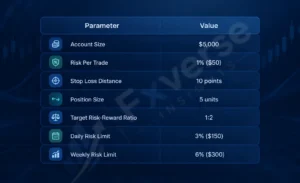
Using this framework, a trader risking $50 per trade with a 1:2 reward ratio would target a $100 gain on winning trades, while limiting total daily losses to $150 across all positions.
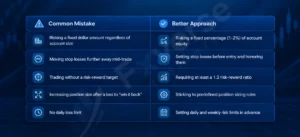
Common Mistake vs Better Approach
Beginner Risk Management Checklist
- Risk per trade is set at 1-2% of total account equity
- Stop loss is placed based on technical analysis, not arbitrary distance
- Position size is calculated using the risk amount and stop loss distance
- Risk-reward ratio is at least 1:2
- Daily and weekly risk limits are defined in advance
- Maximum drawdown tolerance has been considered
- Trading plan is followed regardless of recent wins or losses
Frequently Asked Questions
Is risk management more important than finding a profitable strategy?
Both matter, but risk management in trading determines whether you'll still have capital available to use a profitable strategy long-term. Even a strong strategy can fail without proper risk controls.
How do I calculate position size for a trade?
Divide your risk amount (account size × risk percentage) by your stop loss distance in points or price units. This gives you the number of units, shares, or lots to trade.
What is considered a good risk-reward ratio?
A ratio of 1:2 or higher is generally considered favorable, meaning your potential gain is at least twice your potential loss on any given trade.
Can risk management guarantee profits?
No. Risk management in trading reduces the size and impact of losses, but it cannot guarantee profits or eliminate risk entirely. Markets remain inherently unpredictable.
 Tags:
Tags:

Leave A Comment